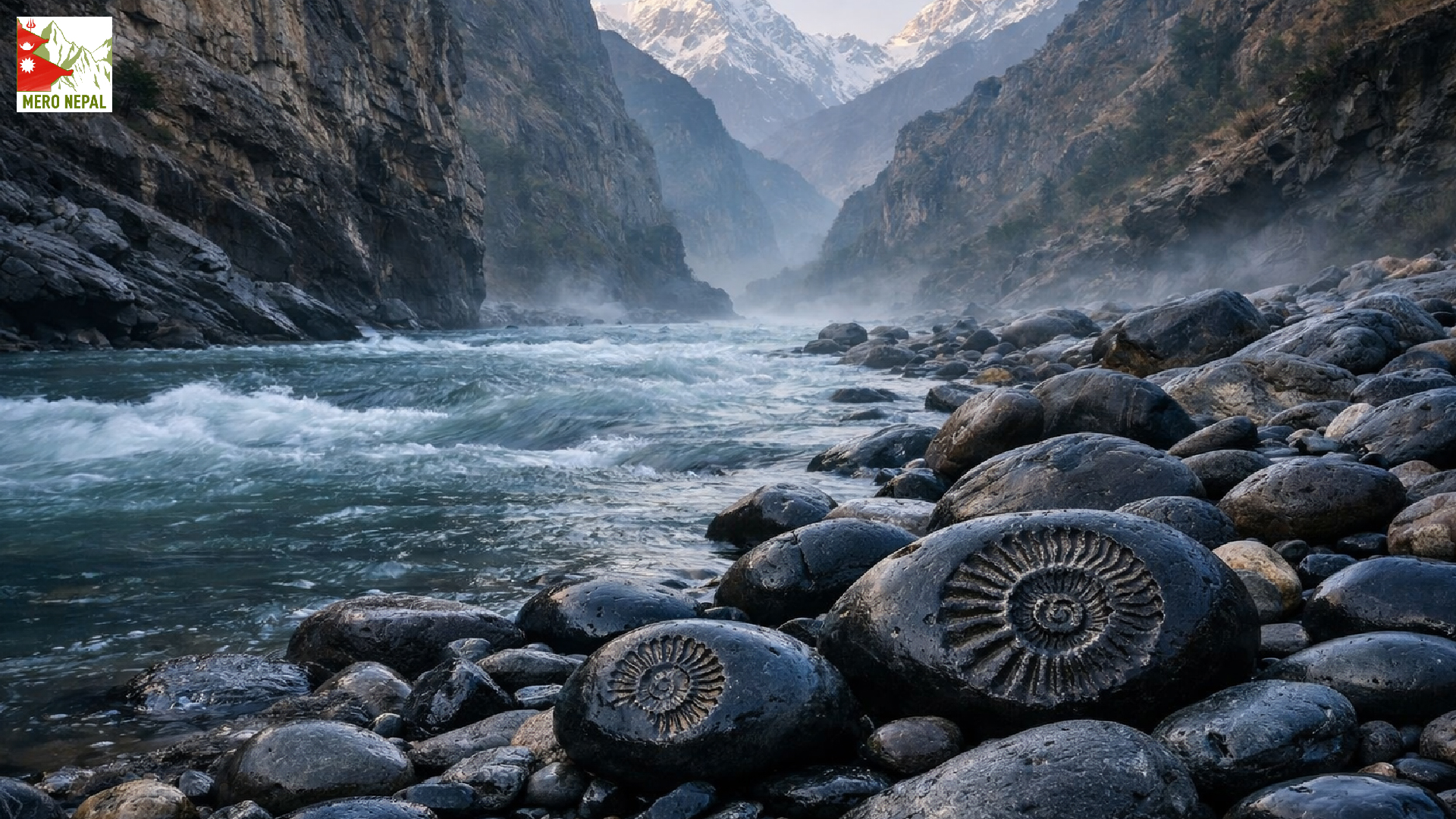
The Kaligandaki River originates in the high Himalayan region of Mustang and flows through Myagdi, Baglung, Parbat, and Syangja before descending toward the plains. It passes through the Kaligandaki Gorge, considered one of the deepest gorges on Earth, lying between the Annapurna and Dhaulagiri mountain ranges.
Historically, the river has served as a vital trade route, pilgrimage path, and cultural corridor, connecting Tibet and the Indian subcontinent. Because of this, the Kaligandaki is often regarded as a river of civilization, not just water.
What Is a Shaligram?
A Shaligram is a naturally formed, smooth, black stone—usually oval or round—marked by spiral patterns, grooves, or openings. According to Hindu scriptures, Shaligrams represent Lord Vishnu in his formless, eternal state.
One of their most distinctive qualities is that they are not carved or modified by humans. Their shapes, symbols, and markings are entirely natural, which makes them uniquely sacred compared to man-made idols.
Shaligram and the Vishnu Tradition
Ancient Hindu texts describe Shaligram worship as one of the purest forms of devotion. Shaligrams are closely associated with Vishnu, Narayana, Krishna, and Lakshmi traditions.
They are used in daily household worship as well as in important rituals such as marriages, ancestral rites, Ekadashi fasts, and major religious ceremonies. Across Nepal and India, thousands of temples and homes continue this tradition to this day.
Scientific Perspective: Fossils Millions of Years Old
From a geological standpoint, Shaligrams are identified as ammonite fossils. Ammonites were ancient marine creatures that lived approximately 140 to 400 million years ago.
The presence of these fossils in the Himalayas proves that this region was once submerged under an ancient ocean. Due to tectonic plate movements, the seabed gradually rose, transforming marine life remains into fossilized stone now found along the Kaligandaki River.
A Rare Union of Religion and Science
What makes Shaligrams exceptional is the peaceful coexistence of belief and scientific explanation. For devotees, a Shaligram is a divine presence. For scientists, it is a record of Earth’s prehistoric life.
Rather than contradicting each other, these perspectives complement one another. Ancient societies preserved these fossils through reverence, allowing modern science to study them today. In this way, faith became an unintentional guardian of natural history.
Why Are Authentic Shaligrams Found Only in the Kaligandaki?
Ammonite fossils exist in other parts of the world, but religiously accepted Shaligrams are recognized only when found in the Kaligandaki region. This belief is rooted in sacred texts, long-standing tradition, and uninterrupted cultural continuity.
This exclusivity gives the Kaligandaki a status that is not just geological, but spiritually irreplaceable.
Cultural, Social, and Pilgrimage Significance
The Kaligandaki corridor is a major pilgrimage route for both Hindus and Buddhists. Sacred destinations such as Muktinath and Damodar Kund attract devotees seeking Shaligrams and spiritual merit.
Local communities have built their rituals, livelihoods, and identity around the river. Thus, Shaligrams are not only religious symbols but also pillars of cultural continuity.
Shaligram Knowledge in the Digital Age
In today’s digital era, younger generations seek reliable spiritual and cultural knowledge online. Addressing this need, the Mero Nepal App provides authentic information on Shaligrams, sacred rivers, pilgrimage sites, Hindu philosophy, and their scientific backgrounds.
🔗 https://play.google.com/store/apps/details?id=com.meronepal.app
The app acts as a digital bridge between ancient wisdom and modern curiosity.
Conclusion
The Kaligandaki River and the Shaligram stones are far more than natural formations. They represent a shared story of Earth’s deep history, human belief, and scientific truth.
Where a Shaligram offers spiritual peace to a devotee, it simultaneously tells a scientist a story millions of years old. This multidimensional significance is what keeps the mystery of the Kaligandaki alive and relevant even today.