1. Introduction and Background of the Study
A close examination of Nepal’s ancient tantric traditions, architectural heritage, and Shaiva philosophy reveals that Hanuman is not merely viewed as a devoted servant of Lord Rama or a secondary deity. In the distinctly Nepali and tantric framework, he is understood as a supreme cosmic force, a fierce manifestation of Lord Shiva, and an eternal being (Chiranjeevi) who continues to exist on Earth to protect dharma.
In particular, the Malla-period history of the Kathmandu Valley, including palace complexes such as Hanuman Dhoka, demonstrates Hanuman’s elevated status as a Kshetrapal (guardian deity) and as Hanu-Bhairava. This article explores his identity as the 11th Rudra, his placement in temples and palaces, the architectural and astrological significance of Hanuman flags, and his enduring role as one of the Ashta Chiranjeevi.
2. Hanuman as the 11th Rudra in Shaiva Philosophy
Shaiva traditions and scriptural sources such as the Shiva Purana identify Hanuman as an incarnation of Lord Shiva—specifically the 11th Rudra. According to the Shatarudriya Samhita, Shiva manifests in various forms to restore balance when the universe is overwhelmed by negativity.
Mythologically, Mother Anjana performed intense penance to please Shiva and Vayu. As a result, Shiva infused his 11th Rudra energy into her womb through Vayu, leading to the birth of Hanuman. Certain tantric and Vaishnava texts describe him as Rudratmaka (of the essence of Rudra), while the Skanda Purana connects him to Nandi, reinforcing his Shaiva identity.
As the 11th Rudra, Hanuman represents not only destructive power but also spiritual awakening (diksha), radiant energy like the sun, and mastery over the five elements—earth, water, fire, air, and space.
3. Hanuman as Guardian of Temples and Palaces
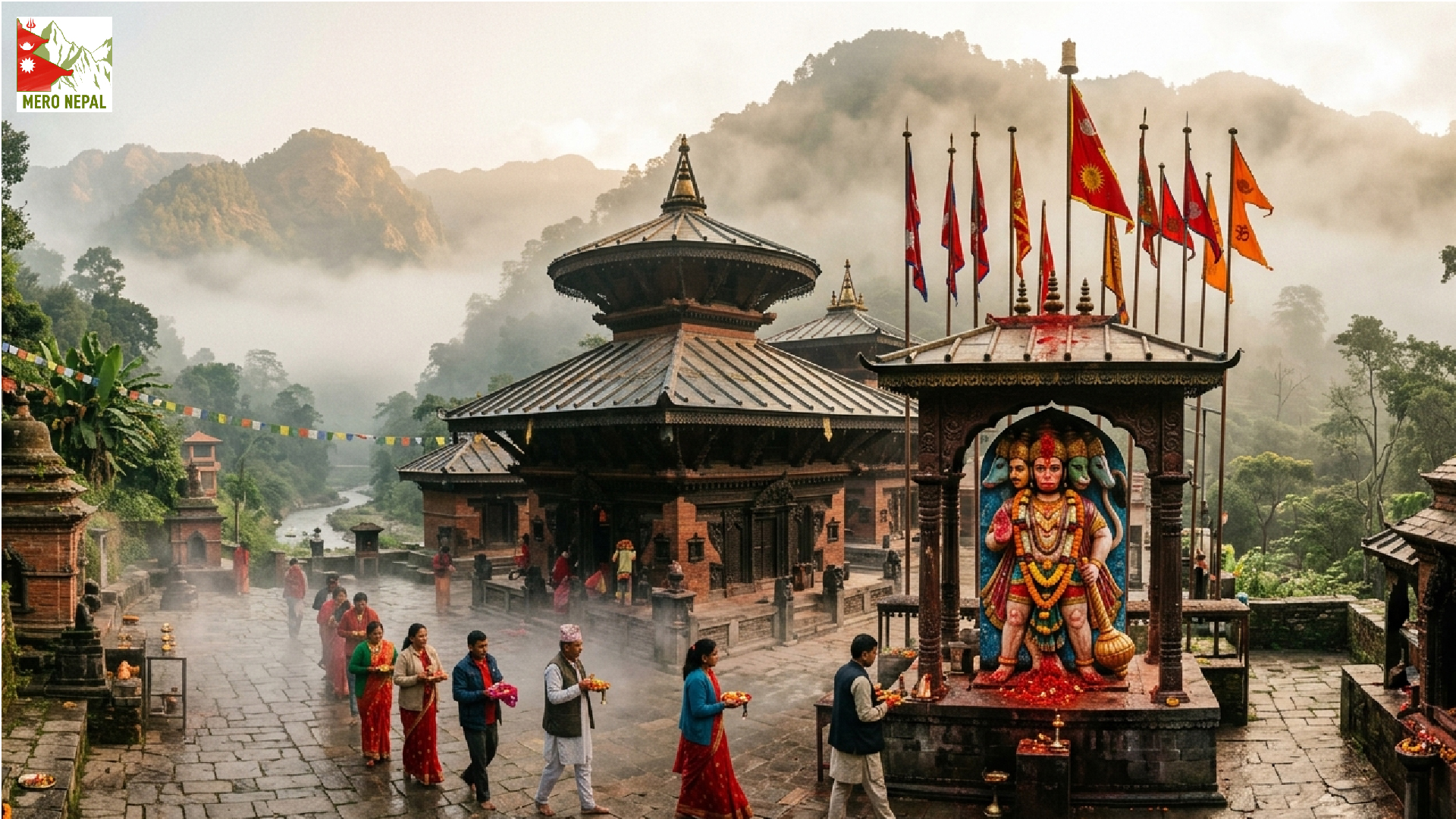
Hanuman statues are commonly placed at the entrances of temples and royal complexes throughout Nepal.
3.1 Kshetrapal and Protector
In tantric belief, temples are highly charged spiritual spaces. To prevent negative forces, spirits, or occult energies from entering, a powerful guardian is required. Hanuman fulfills this role as an invincible protector.
King Pratap Malla installed a prominent Hanuman statue at Kathmandu Durbar Square in 1672 AD, which led to the naming of Hanuman Dhoka. The statue is covered in red cloth and vermilion, symbolizing activated divine energy.
3.2 Association with Taleju Bhawani
Taleju Bhawani, the royal goddess of the Malla kings, is a fierce tantric form of Durga. Her temples are guarded by Hanuman, often in the form of Panchamukhi Hanuman or Hanu-Bhairava, capable of balancing her intense energy.
3.3 Psychological Role
The presence of Hanuman at temple entrances instills courage, removes fear, and prepares devotees mentally for deeper spiritual engagement.
4. Hanuman Bhairava and the Panchamukhi Form
In Nepal’s tantric art and architecture, Hanuman is frequently depicted as Hanuman Bhairava, a fusion of Shaiva and Vaishnava traditions.
4.1 Symbol of Power and Victory
Malla kings revered Hanuman as a symbol of military strength and protection. Historical texts suggest that flags bearing Hanuman’s image were believed to weaken enemy forces.
4.2 Panchamukhi Hanuman
The five-faced form represents control over directions and elements:
- Hanuman (East): Courage and destruction of ignorance
- Narasimha (South): Protection from fear
- Garuda (West): Protection from poisons and occult forces
- Varaha (North): Stability and prosperity
- Hayagriva (Upward): Knowledge and spiritual growth
This form is considered highly powerful in tantric practice and is often depicted with multiple arms holding symbolic weapons.
5. Vastu and Astrological Significance
5.1 Hanuman Flag and Ketu
In astrology, flags are associated with the planet Ketu, representing liberation and spiritual growth. Installing a Hanuman flag on rooftops is believed to neutralize negative influences and attract positive energy.
5.2 Placement in the Home
- North: Enhances wealth and stability
- East: Promotes health and positivity
- Prayer room: Strengthens devotion and focus
Hanuman imagery also contributes to psychological strength, courage, and emotional balance.
6. Hanuman as Ashta Chiranjeevi
Hanuman is one of the eight immortal beings (Ashta Chiranjeevi):
Bali, Parashurama, Vyasa, Hanuman, Vibhishana, Kripacharya, Ashwatthama, and Markandeya.
6.1 Role in Kaliyuga
Hanuman is considered the most active protector of dharma in the current age. He is believed to be present wherever divine names are sincerely recited.
At the end of Kaliyuga, he will assist Lord Kalki in restoring righteousness.
6.2 Role in Yogic Traditions
In Nath and yogic traditions, Hanuman is regarded as a master of prana and Hatha Yoga, possessing the eight siddhis (spiritual powers).
7. Sacred Geography and Sightings in Nepal
7.1 Hanuman Ghat, Bhaktapur
A sacred confluence site where a legend states Hanuman created the Tamasa River by striking the ground. It is believed he still visits this place invisibly.
7.2 Himalayan Traditions
Accounts from saints and practitioners describe sightings or experiences of Hanuman in Himalayan regions, reinforcing the belief in his continued presence.
8. Conclusion
Hanuman, within Nepal’s tantric and Shaiva traditions, is far more than a mythological figure. He is the 11th Rudra, a cosmic force governing balance, protection, and spiritual awakening.
As a guardian deity, tantric power, and eternal protector of dharma, his presence spans temples, architecture, spiritual practices, and sacred geography across Nepal.
He embodies strength, devotion, and guidance—remaining an ever-living force in both the physical and spiritual realms.