Introduction
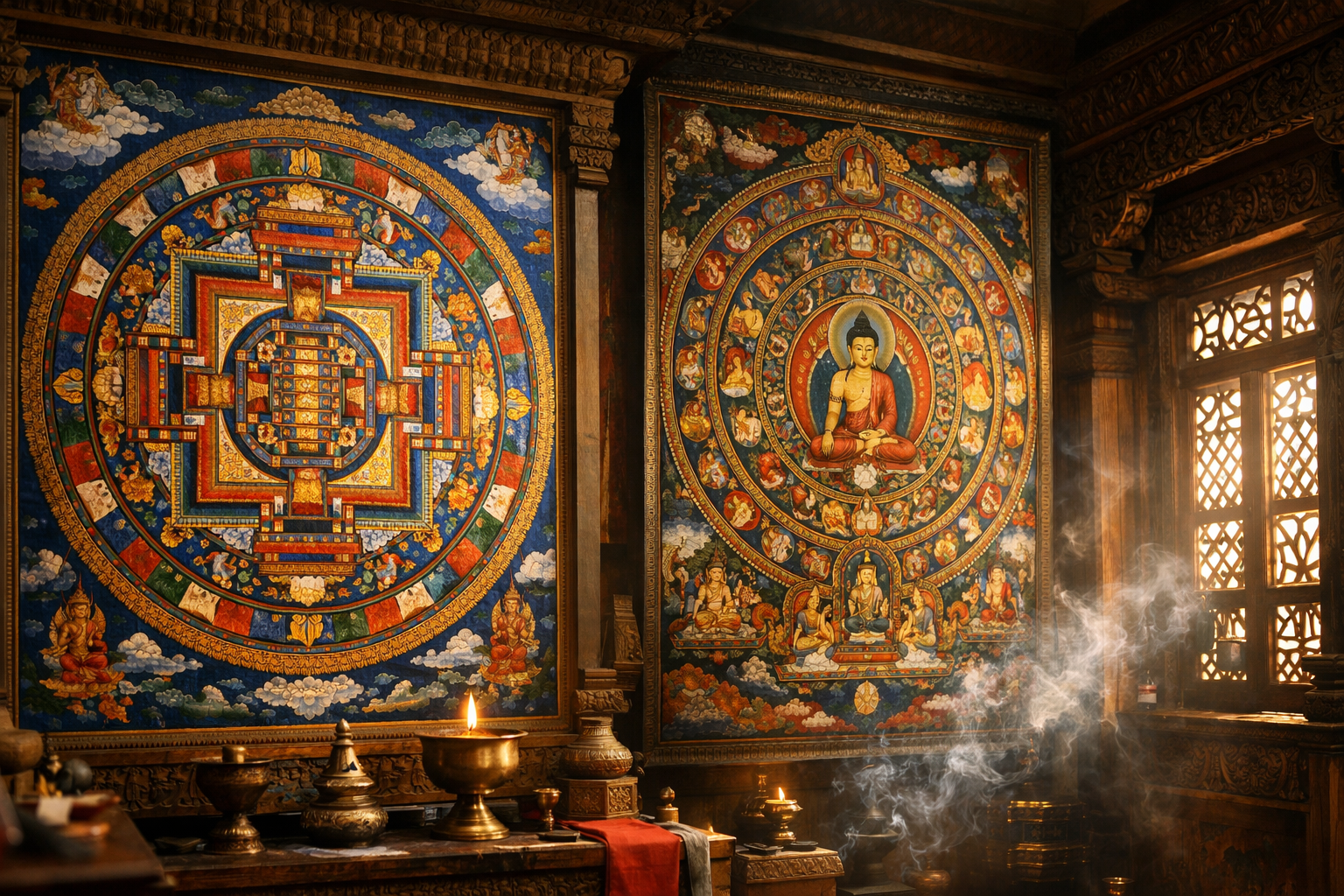
Thangka and Paubha are not merely artistic creations. In Nepali and Tibetan Buddhist traditions, they serve as essential tools for meditation, worship, and spiritual practice. Every color, line, symbol, and geometric structure within these paintings is deeply connected to the human mind, consciousness, and the balance of cosmic energy.
The history of Thangka and Paubha spans thousands of years. These artworks were never intended only for decoration on walls or cloth. Instead, they function as visual guides for meditation, instruments of spiritual discipline, and teaching tools within the guru–disciple tradition. To understand the convergence of art, religion, science, and human awareness, the study of Thangka and Paubha is indispensable.
Thangka and Paubha: Definition and Distinction
-
Thangka: A Buddhist religious painting traditionally created on cloth or canvas, primarily used for meditation, visualization, and ritual worship.
-
Paubha: A traditional Newar painting style from Nepal that depicts deities, sacred narratives, and cosmic structures, often used in rituals and social-religious contexts.
Key Differences
| Aspect | Thangka | Paubha |
|---|---|---|
| Primary purpose | Meditation and worship | Ritual, social, and cultural use |
| Artistic style | Tibetan/Lama Buddhist | Newar classical style |
| Structure | Mandala-centered | Narrative and deity-centered |
Thangka is more focused on meditative visualization, while Paubha is deeply embedded in social, cultural, and ritual life.
The Spiritual Significance of Color
Colors in Thangka and Paubha are not chosen for aesthetic appeal alone. Each color carries psychological, emotional, and spiritual meaning.
Common Colors and Their Meanings
-
Red: Vitality, power, protection
-
Blue: Calmness, infinity, deep meditation
-
Yellow: Wisdom, intellect, clarity
-
Green: Balance, healing, harmony
-
White: Purity, compassion, spiritual clarity
-
Black: Protection and the removal of negative forces
The harmonious combination of these colors helps balance mental states, emotional energies, and cosmic forces, making them effective tools for meditation and spiritual focus.
Cosmic Geometry and Mandala Structure
Geometric precision is central to both Thangka and Paubha.
-
Mandala: Represents the cosmic universe and serves as the focal point for meditation.
-
Circles and triangles: Symbolize stability, movement, power, and balance.
-
Proportional symmetry: Reflects natural and universal laws.
-
Central point (Bindu): Guides concentration and symbolizes the source of creation.
These geometric arrangements help practitioners deepen concentration, stabilize the mind, and connect individual consciousness with universal order.
Historical Background
Thangka and Paubha evolved through Tibetan, Newar, and Himalayan Buddhist traditions.
-
Thangka developed primarily within monasteries, supporting ritual practices and advanced meditation.
-
Paubha flourished among the Newar community, integrating religious narratives with social ceremonies and festivals.
Each painting functions not only as visual art but also as a didactic medium, spiritual map, and ritual instrument.
Use in Meditation and Spiritual Practice
Thangka and Paubha play a vital role in contemplative practices.
-
Meditating on the mandala’s center enhances mental stability.
-
Colors assist in emotional regulation and mental clarity.
-
Deities and symbols guide practitioners toward deeper spiritual awareness.
Beyond spirituality, these artworks support mental well-being, stress reduction, and focused awareness, making them relevant even in contemporary contexts.
Social and Cultural Importance
Thangka and Paubha are not limited to personal practice; they are integral to community and cultural life.
-
Used in monasteries, temples, and household worship
-
Displayed during festivals, rituals, and religious events
-
Employed in teaching spiritual philosophy and moral values
They demonstrate the harmonious relationship between art, religion, and society in Nepal.
Traditional Knowledge in the Digital Age (App Promo)
In the modern era, younger generations increasingly seek access to traditional knowledge through digital platforms. To meet this need, the Mero Nepal App provides authentic information on Nepali culture, Thangka and Paubha art, spiritual symbolism of colors, and cosmic geometry.
🔗 https://play.google.com/store/apps/details?id=com.meronepal.app
Key features of the app include:
-
In-depth explanations of Thangka and Paubha traditions
-
Symbolic meanings of colors and geometric structures
-
Guidance on meditation, yoga, and spiritual practices
-
A growing digital archive of Nepali art and cultural heritage
The app acts as a bridge between ancient wisdom and modern accessibility.
Conclusion
Thangka and Paubha are far more than visual artworks. They are spiritual instruments, conveying profound teachings through color, geometry, and symbolism. Through these paintings, the relationship between the human mind, consciousness, and the cosmos becomes visible.
When studied and practiced correctly, Thangka and Paubha offer not only visual beauty but also mental clarity, emotional balance, and spiritual awakening. In the digital age, platforms like the Mero Nepal App play a crucial role in preserving and transmitting this invaluable heritage for future generations.