

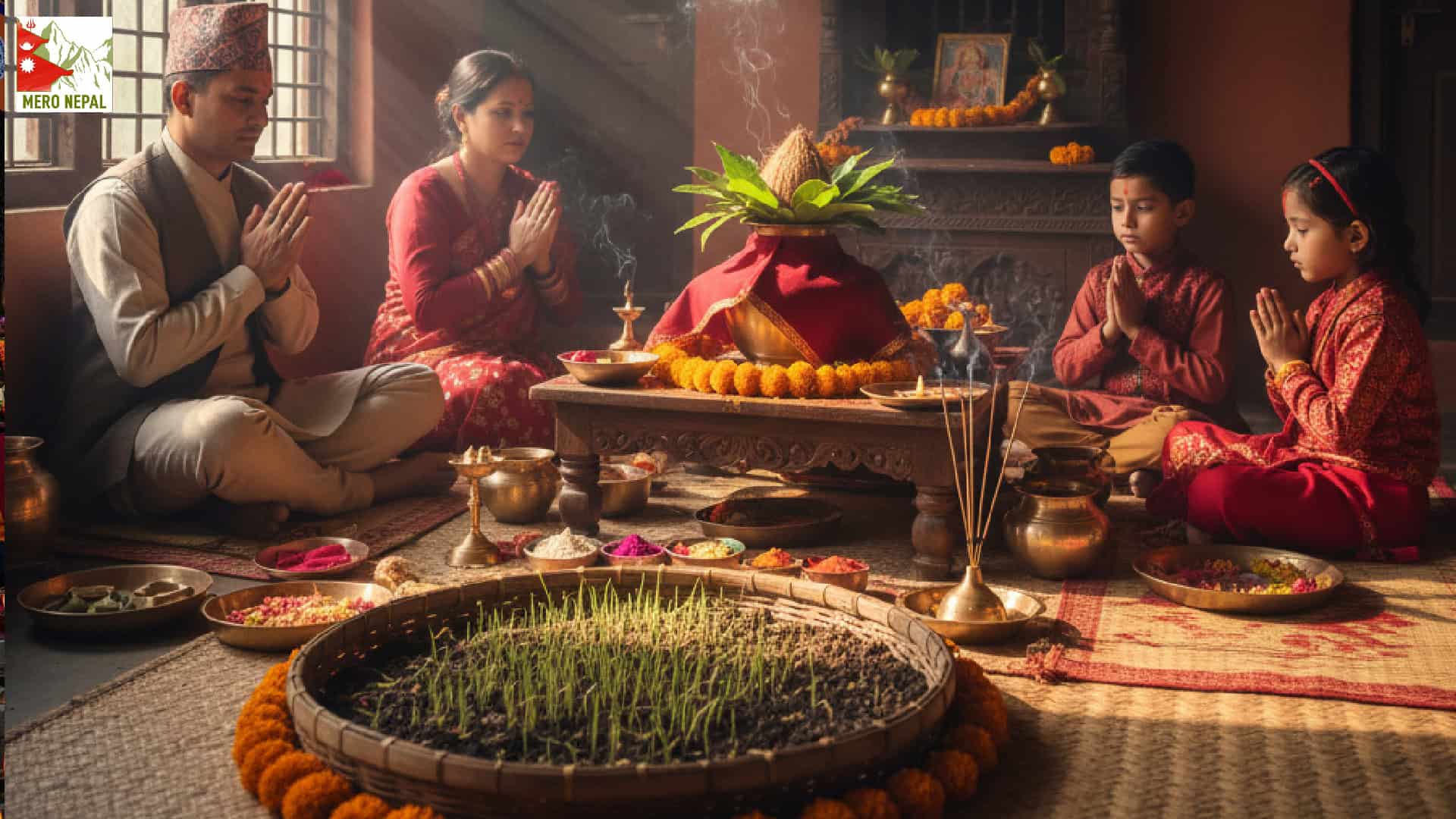
Dashain, Nepal’s biggest festival, begins with Ghatasthapana. This day holds immense religious, cultural, and spiritual significance. The fifteen-day festival starts with this ritual, which sets the tone for the celebrations. On this day, Goddess Durga is invoked, and jamara (barley sprouts) are sown, which later become central to the entire Dashain rituals.
Rituals of Ghatasthapana
The word Ghatasthapana is derived from two Sanskrit terms: ghata (sacred pot) and sthapana (to establish). It means the establishment of a holy vessel.
1. Preparation of the Worship Room
Early in the morning, the prayer room or a sacred corner of the house is cleaned and purified.
A bed of soil or sand is prepared, where barley, wheat, and maize seeds are sown.
2. Establishing the Kalash
A sacred vessel (kalash) is filled with holy water, betel nut, grains, and coins, then covered with cow dung.
Mango leaves or jamara leaves are placed inside, wrapped with a red cloth as a symbol of power.
A coconut is placed on top of the kalash, representing purity and fertility.
3. Worship and Mantras
The head of the household or a priest chants Vedic mantras to invoke Goddess Durga into the kalash.
Flowers, rice grains, tika, incense, and oil lamps are offered.
The auspicious time (shubh muhurat) for Ghatasthapana is fixed by astrologers, and the rituals are performed accordingly.
4. Sowing of Jamara
The seeds sown on this day are watered daily and kept away from sunlight.
By Vijaya Dashami, the sprouts grow about 5–6 inches long, turning golden yellow.
These jamara are distributed along with tika as blessings from the Goddess.
Symbolism of Ghatasthapana
The kalash symbolizes the divine power of Goddess Durga.
Jamara represents prosperity, fertility, and agricultural abundance.
This ritual highlights the bond between nature and spirituality.
It is believed that Ghatasthapana invites the Goddess’s presence into the home, blessing the family with health, longevity, and success.
Cultural Importance
Ghatasthapana is not limited to households but is also observed on a community level. Major rituals are held at Hanuman Dhoka Durbar in Kathmandu, Gorkha Durbar, and other historic temples. Thousands of devotees gather to witness the sacred moment.
In villages, families perform the ritual with devotion, and the jamara emphasizes the agricultural roots of Dashain, linking harvest and fertility with goddess worship.
Ghatasthapana and Navadurga Worship
Ghatasthapana also marks the beginning of Navaratri. Over the nine nights of Navaratri, devotees worship the nine forms of Goddess Durga—from Shailaputri to Siddhidatri. Thus, Ghatasthapana is not only the start of Dashain but also the foundation of Navadurga worship.
Make Your Dashain More Special with Mero Nepal App
Enhance your Dashain celebrations with the Mero Nepal App. With it, you can:
Learn the rituals and significance of each day of Dashain.
Access auspicious timings, ritual materials, and mantras.
Get reminders for tika and jamara distribution.
Easily share festival moments with your family and relatives.
📱 Download Mero Nepal today and make your Dashain more meaningful and convenient.
Conclusion
Ghatasthapana is not just a ritual but a spiritual process of invoking Goddess Durga. It preserves cultural values of fertility, prosperity, and devotion. With the establishment of the kalash and sowing of jamara, Nepali families begin fifteen days of prayer, celebration, and togetherness. For devotees, Ghatasthapana is more than just the first day of Dashain—it is the seed of hope, prosperity, and divine protection for the entire year.


