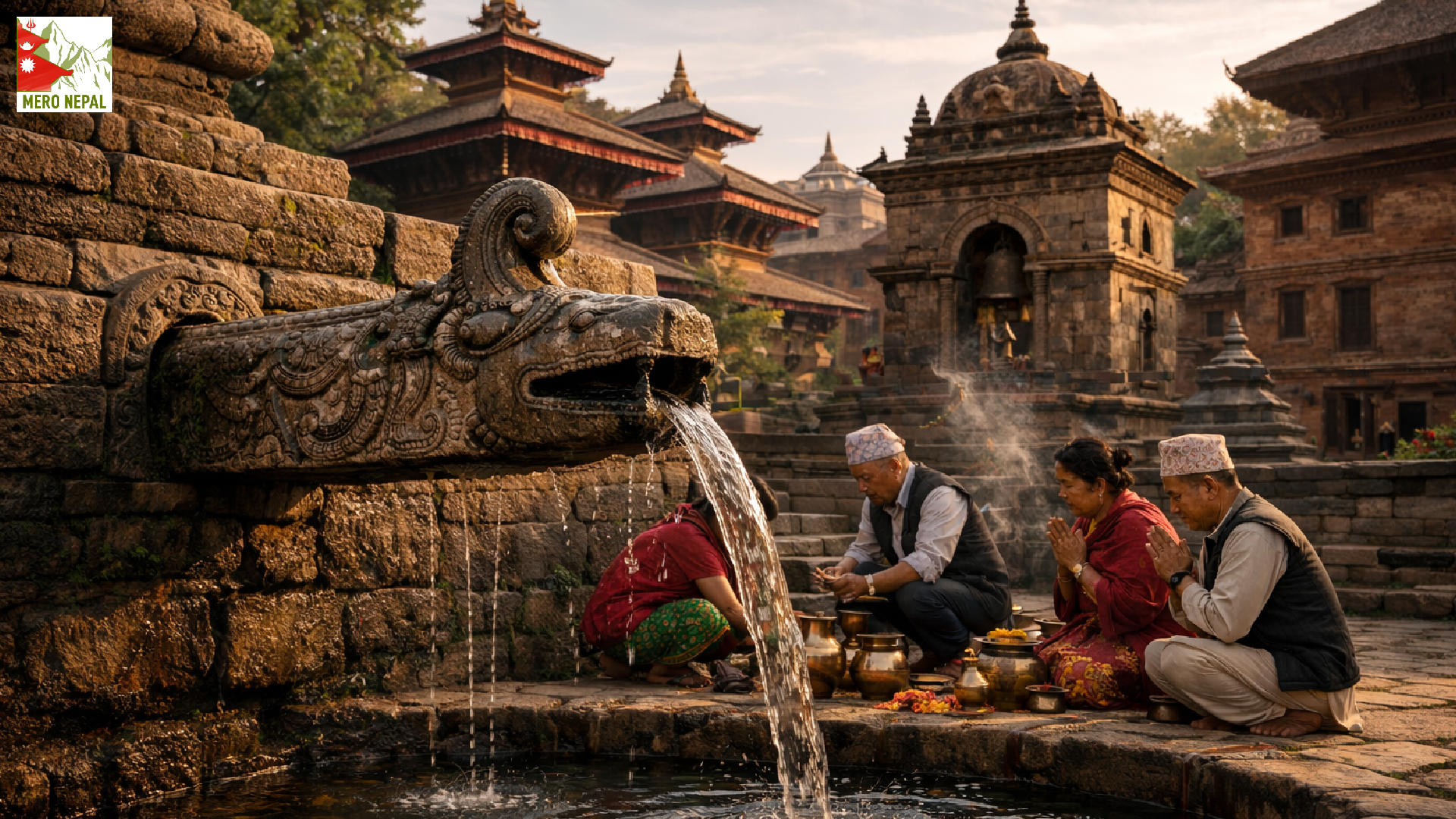
In Nepal, water is not only a source of life but also deeply significant in religious, cultural, social, and environmental contexts. The Himalayan region has a water management history spanning thousands of years. Ancient systems developed here have contributed significantly to natural resource conservation, social cohesion, religious practices, and ecological balance.
Nepal’s Dhunge Dhara, also known as the “Veins of the Earth,” are exemplary structures of ancient water management, architecture, religious belief, and social organization.
1. Historical Background
The history of Dhunge Dhara is closely linked with the ancient Nepalese civilizations of the Lichhavi and Malla periods.
Lichhavi Period (5th–8th century): Stone spouts and water basins were constructed in the Kathmandu Valley to ensure a stable supply of drinking water.
Malla Period (12th–18th century): Kings emphasized architectural beauty and religious significance in Dhunge Dhara construction. Notable examples in Bhaktapur, Patan, and Kathmandu were built during this era.
Modern Era: While modern water systems have reduced the practical use of many Dhunge Dhara, their cultural significance remains alive.
The detailed locations, historical, religious, and cultural information of these spouts and basins can be easily accessed through the MeroNepal App.
2. Architecture and Structural Features
Dhunge Dhara is more than a water source; it is a remarkable combination of Nepali architecture and water engineering.
Stone pillars and basins: Durable and long-lasting construction.
Irrigation channels: Gravity-fed distribution systems in hilly terrain.
Decorative and sculptural elements: Nalas (water spouts) often feature carvings of deities, animals, and symbolic motifs.
Famous Dhunge Dhara in Nepal
Kathmandu: Hanuman Dhoka Durbar area spouts, stone basins, and sculptures.
Bhaktapur: Suryakund, Goldhar, Dhwaj Dhara.
Patan: Stone basins in the Ratnapark area.
The MeroNepal App provides detailed information, GPS locations, and images of all major spouts and basins in Nepal.
3. Religious and Cultural Significance
Dhunge Dhara and water basins are not only physical water sources but also central to Nepalese religious and social life.
Rituals and Ceremonies
River and spout worship: During Hindu festivals like Chhath, Shivaratri, and Tihar.
Life rituals: Used in weddings, birthdays, and housewarming ceremonies.
Vows and local festivals: Ensures the sanctity of water in religious observances.
Social Structure
Community gathering points: Villagers and city dwellers meet at spouts daily.
Shared responsibility: Maintenance, cleanliness, and equitable water distribution.
Passing knowledge to new generations: Elders teach younger members the importance of water conservation.
Through the MeroNepal App, users can access detailed guidance on rituals, local festivals, and spout locations.
4. Environmental and Geographic Contributions
Dhunge Dhara systems play a vital role in natural resource conservation.
Collecting rainwater via basins and channels.
Maintaining soil stability and preventing erosion.
Supporting biodiversity by providing habitats for aquatic and terrestrial species.
The MeroNepal App also shows geographic details, maps, and environmental significance of water sources across Nepal.
5. Modern Challenges
Dhunge Dhara faces several challenges in contemporary times:
Urbanization: Many old spouts and basins have been destroyed.
Pollution: Industrial and household waste contaminates water.
Neglect of traditional sources: Modern water systems often overlook these heritage structures.
Lack of awareness: Communities may not fully understand their importance.
The MeroNepal App provides guidance to citizens on participating in conservation efforts.
6. Conservation and Revival Measures
Community Initiatives: Local involvement in cleaning, maintenance, and preservation.
Government and NGO Efforts: Restoration, heritage conservation, and pollution control.
Education and Awareness: Programs in schools and communities to raise awareness of water heritage.
Users can also use the MeroNepal App to participate in local water conservation campaigns.
7. Future and Sustainable Development
Nepal can combine traditional water management with modern technology for sustainable development:
Smart water management: Digital monitoring of spouts and basins.
Pollution control: Prevent industrial and domestic waste contamination.
Cultural preservation: Combining religious, cultural, and environmental approaches.
Tourism promotion: Turn spouts and basins into tourist attractions to support the local economy.
The MeroNepal App serves as a digital platform for monitoring, reporting, and involving the community in preservation efforts.
8. Social and Economic Dimensions
Dhunge Dhara and water management also have social and economic importance:
Local employment: Conservation, restoration, and tourism activities.
Water tourism: Historical spouts, basins, and rivers as attractions.
Community development: Conserving water sources strengthens social cohesion and local economy.
The MeroNepal App makes participation in tourism and conservation projects easier for everyone.
9. Conclusion
Dhunge Dhara is not merely a water source; it is an integral part of Nepal’s cultural, religious, social, and environmental heritage. Modern management, conservation efforts, and awareness campaigns ensure its sustainability.
Every spout, basin, and river in Nepal teaches us about life, culture, history, and the future. Protecting these water sources means preserving our identity, environment, and religious traditions.
Experience Nepal’s sacred water and historic spouts on your mobile today with the MeroNepal App.
Download on Google Play