1. Introduction: The Heart of the Household
In the Western world, a kitchen is often viewed through the lens of functionality—a place for appliances and meal preparation. However, in the Nepali worldview, the Chulo (traditional mud hearth) represents the literal and metaphorical center of existence. It is the seat of Agni (the God of Fire), the primary pharmacy of the family, and a sacred boundary that separates the “ordered home” from the “chaotic outside.”
For centuries, the Nepali kitchen has operated under a complex set of ritualistic laws known as Chokho-Nito (Pure vs. Impure). While often dismissed by outsiders as mere superstition, these practices form a sophisticated system of pre-scientific public health and social cohesion that has allowed Nepali communities to thrive in diverse and often harsh environments.
2. The Architecture of the Sacred: Spatial Sanctity
Traditional Nepali architecture is not just about shelter; it is about spiritual geography. The kitchen’s location is never accidental.
The Verticality of the Newari Home
In the Kathmandu Valley, traditional Newari houses rise vertically. The kitchen, or Baudh, is situated on the topmost floor.
-
Proximity to the Divine: Being at the highest point, the kitchen is closest to the gods and furthest from the “impurities” of the street.
-
Smoke as a Structural Preservative: Traditional homes utilize wood and mud. The smoke from the wood-fired Chulo permeates the wooden beams (dalin), acting as a natural pesticide against termites and wood-boring beetles. This “unintentional” engineering has kept homes standing for centuries.
The Inner Sanctuary of the Hills and Plains
In the mid-hills and Terai, the kitchen is often a separate room or a corner of the house with a strictly controlled entrance.
-
The Threshold: Entering a kitchen with “outerwear” or shoes is strictly forbidden. Shoes carry the “dust of the world,” which includes physical waste and the negative energy of strangers. By removing them, the family creates a sterile zone that rivals modern surgical theaters in its conceptual purity.
3. The Ritual of ‘Lip-Pot’: The Daily Rebirth of the Hearth
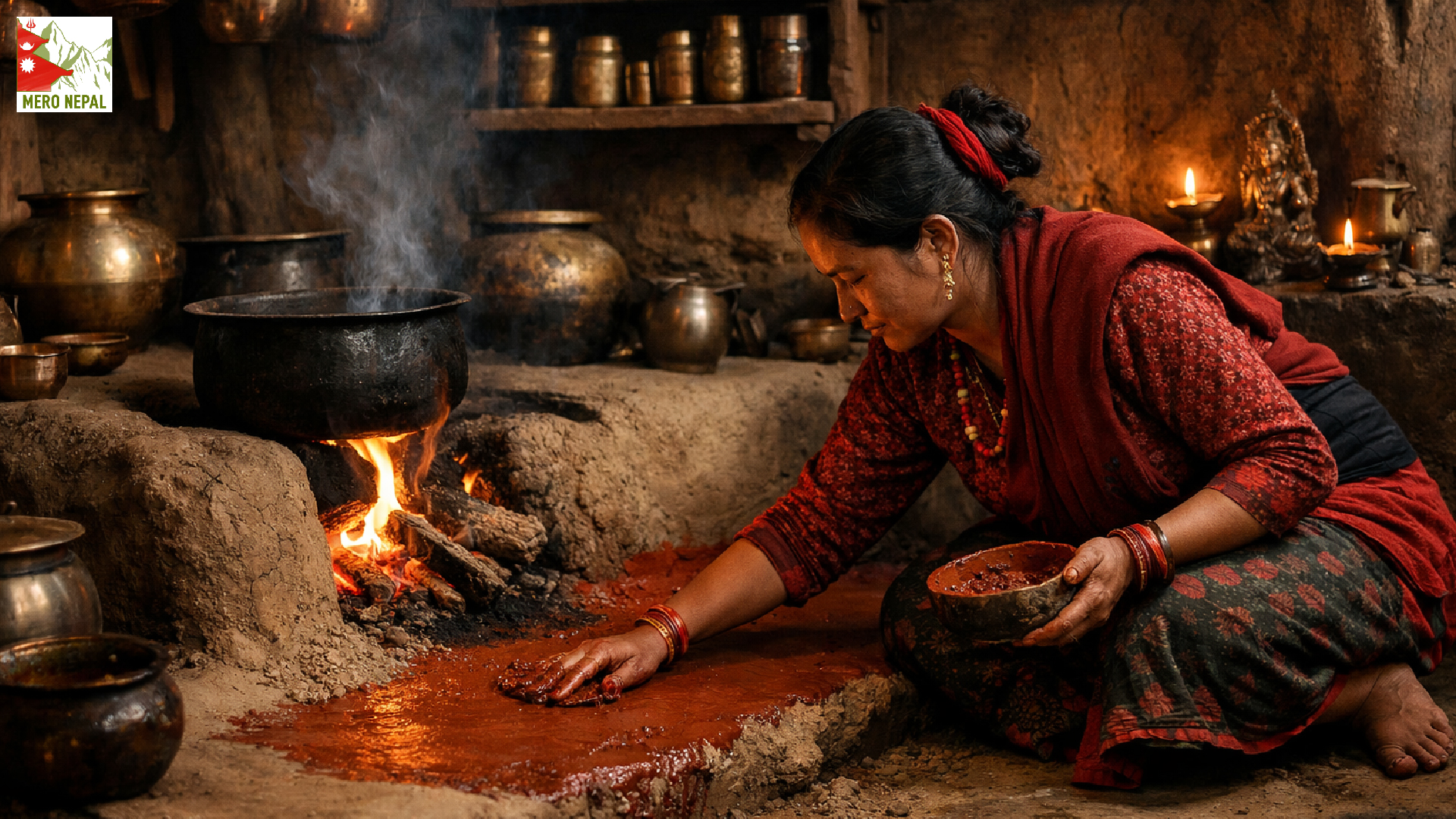
Every morning, before the sun reaches its zenith, the woman of the house performs the ritual of Lip-Pot. Using a mixture of Rato Mato (red clay) and Gobar (cow dung), she hand-plasters the Chulo and the surrounding floor.
The Alchemical Mixture
-
The Symbolism of Red Clay: Red is the color of life, blood, and the Goddess. By applying red clay, the hearth is symbolically “reborn” every day.
-
The Antiseptic Properties of Cow Dung: While modern sensibilities might recoil at the use of dung, traditional knowledge (supported by emerging research) suggests that cow dung contains microbes and chemical properties that act as a natural disinfectant. When it dries, it forms a hard, smooth, and dust-resistant surface that is significantly more hygienic than a raw dirt floor.
4. The Fire Mythos: Agni and the Ancestors
The fire within the Chulo is not just a heat source; it is a living deity.
The Ritual of Panchagras
Before a single morsel of food is consumed by the family, the first five portions (Panchagras) are offered to the fire. This is a tribute to:
-
Agni (The God of Fire)
-
Pitris (The Ancestors)
-
Panchabhuta (The Five Elements)
-
Ishta Devata (The Personal God)
-
Bhutas (The spirits of nature)
This practice fosters a deep psychological connection to the environment, reminding the household that they are part of a larger ecological and spiritual cycle.
5. The Kitchen Pharmacy: The Science of the Masala Dani
The Masala Dani (spice box) is the heart of the Nepali Chulo. Every spice added to the pot serves a medicinal purpose defined by Ayurveda.
The Big Three: Turmeric, Ginger, and Garlic
-
Besar (Turmeric): Known as the “Golden Spice,” its active compound, curcumin, is a powerful anti-inflammatory. In the Nepali kitchen, it is the universal healer—used for everything from flavoring lentils to treating wounds.
-
Aduwa (Ginger) and Lasun (Garlic): These are “heating” foods. In the cold Himalayan climate, they are essential for maintaining core body temperature and acting as natural antibiotics.
The Digestive Guardians
-
Jimbu (Himalayan Aromatic Leaf): Often used to temper black lentils (Maas ko Daal), it is believed to reduce the flatulence and bloating associated with legumes.
-
Timur (Szechuan Pepper): A potent anesthetic and digestive stimulant, Timur is vital for oral health and gut motility in high-altitude regions.
6. The “Evil Eye” (Najar) and Mindful Consumption
One of the most misunderstood aspects of the Nepali kitchen is the secrecy surrounding meals.
The Psychology of Najar
It is believed that the “energy” of a witness can affect the food. If someone looks at your plate with envy or hunger, the food becomes “polluted” (Najar Lageko).
-
The Hygiene Logic: By restricting who sees and touches the food, the family minimizes the risk of communicable diseases.
-
The Mindfulness Factor: Eating in a private, quiet space allows for proper focus on the meal, which triggers the parasympathetic nervous system, leading to better nutrient absorption.
7. Gender Roles and the Matriarchal Power
While the kitchen is often seen as a place of labor, in the Nepali context, it is also a seat of power. The mother or grandmother who manages the Chulo is the “Annapurna” (Goddess of Food) of the house. She decides the health of the family, manages the resources, and ensures that the spiritual laws of the home are upheld. The kitchen is her domain, where even the patriarch must follow her rules regarding purity and entry.
8. The Modern Transition: From Clay to Induction
Nepal is currently in a state of “Energy Transition.”
-
Indoor Air Pollution: Traditional Chulos without chimneys contribute to respiratory issues.
-
The “Clean Chulo” Movement: Non-profits and the government are promoting Improved Cooking Stoves (ICS) and electric induction cooktops.
-
The Preservation of Essence: Even in modern apartments in Kathmandu, the spirit of the Chulo remains. The “no-shoe” policy, the ritual of cleaning the stove before cooking, and the respect for the first serving of food remain deeply embedded in the modern Nepali psyche.
9. Comparative Analysis: Tradition vs. Science
| Traditional Concept | Ritual Name | Scientific/Modern Parallel |
| Purity/Impurity | Chokho-Nito | Sterilization and Cross-Contamination Prevention. |
| Saliva Contamination | Jutho | Prevention of droplet-borne pathogens (Flu, Meningitis). |
| Morning Cleaning | Lip-Pot | Daily sanitization of high-touch surfaces. |
| First Offering | Agni Puja | Psychological grounding and stress reduction. |
| Restricted Access | Najar Protection | Quarantine/Social Distancing in food prep areas. |
10. Conclusion: A Holistic Way of Life
The Nepali Chulo is a masterpiece of cultural evolution. It combines architecture, religion, medicine, and social hierarchy into a single, cohesive system. By understanding the Chulo, one understands the Nepali people—their resilience, their respect for nature, and their unwavering commitment to the sanctity of the home.
As we move toward a more globalized world, the lessons of the Chulo—mindfulness, hygiene-as-holiness, and food-as-medicine—remain more relevant than ever.