1. Introduction: The Ocean of Existence and Ancestral Debt
Human life is not just a pile of flesh and bones, nor merely the fleeting beat of the present moment. From the vast perspective of Vedic Sanatan Dharma, an individual is never truly complete in themselves; they are an unbroken link of blood, culture, consciousness, and karma flowing across eternity. When a newborn cries for the first time, they do not come alone. They carry in their veins the blood of grandparents, the love of ancestors, the dreams of forefathers, and the karmic burdens of countless generations before them. What we call “I” is actually “we”—the collective existence of a vast lineage.
Within this ocean of existence, where the boundary between life and death is blurred, a profound, mysterious, and sometimes frightening subject arises in astrology and dharma: Pitra Dosh. Hearing the term often evokes the sense of a curse, fear, or cloud of misfortune. But is it really a curse from ancestors? Could those revered forefathers, who gave us life and body, intentionally bring suffering to their descendants? This question is deeply emotional and shakes the foundation of belief.
This research report aims to cut through market rumors and superstition, delving into the Vedas, Upanishads, Puranas, and authentic astrological texts to reveal the true nature of Pitra Dosh. It goes beyond mere planetary calculations, touching the mysterious bridge where the realm of ancestors meets the realm of death. We explore how the unfulfilled desires of one generation become obstacles for the next, how mistakes in history shape destiny, and, most importantly, how “Dosh” can be transformed into “Moksha” (liberation).
The report meticulously explains the classical definition of Pitra Dosh, its origin, astrological basis, scriptural evidence, and its scientific and psychological aspects. It is not just a report—it is a dialogue with our roots, a tribute to forgotten ancestors, and a spiritual journey of self-discovery.
2. Philosophical and Conceptual Discussion on Pitra Dosh
2.1 Etymology of ‘Pitra’ and ‘Dosh’
In Sanskrit literature, Pitra does not merely mean “father.” It literally means “one who nurtures and protects.” Spiritually, Pitra refers to the collective consciousness of deceased ancestors—fathers, grandfathers, great-grandfathers, and maternal ancestors. Some Pitris are liberated and reside in higher realms (Pitra Lok), while others remain unfulfilled, wandering in lower realms (Preta Yoni).
Dosh derives from Dush and signifies imperfection, flaw, imbalance, or defect. Hence, Pitra Dosh is not a curse from ancestors, but the cry of unfulfilled ancestral souls—a kind of energy blockage in the family lineage. Like a tree whose roots are infested, the branches (children) suffer, and the fruits are bitter or fail to grow.
2.2 Difference Between Pitra Dosh and Ancestral Debt
While many scholars use Pitra Dosh and Pitra Rin (Ancestral Debt) interchangeably, there is a subtle difference:
-
Pitra Dosh (Ancestral Fault): Related to unfulfilled obligations or disturbances, e.g., untimely death in the family or improperly conducted funeral rites. This unrest manifests in descendants’ horoscopes as obstacles in marriage, health, or lineage.
-
Pitra Rin (Ancestral Debt): Relates to karmic burden. If ancestors committed sins (murder, theft, temple desecration, or insult to a guru/Brahmin), the descendants inherit this debt. Nature’s law ensures the debt is settled, whether through wealth, action, or karma.
2.3 Scientific Perspective: Genetics and Culture
Modern genetics and epigenetics offer a lens to understand Pitra Dosh. Humans inherit 50% of DNA from each parent, but epigenetics shows that extreme ancestral stress, trauma, or fear can influence descendants’ genes. If a grandfather experienced deep depression or anger, this may manifest in grandchildren. Astrology reflects this through planetary positions—malefic Rahu or Saturn influence signals ancestral trauma. Thus, Pitra Dosh is not superstition but a profound science of cause and effect.
3. Scriptural Evidence: From Vedas to Puranas
3.1 Atharvaveda: Reverence and Fear of Ancestors
Ancestors are considered akin to gods, sometimes even closer than deities. Atharvaveda mentions rituals and offerings to satisfy ancestors, highlighting misfortunes that arise if neglected. It also refers to hereditary diseases and their remedy through prayers and offerings.
3.2 Garuda Purana: Post-Death Reality
Garuda Purana elaborates on the journey of the soul, Preta Yoni, and unrest due to improper funeral rites. Ancestors who are unfulfilled may cause subtle disturbances in their descendants’ lives if Tarpan (water offerings) is not given.
3.3 Manusmriti: Obligation of Pitra Yajna
According to Manusmriti, among the five major Yajnas of human life, Pitra Yajna is mandatory. Without fulfilling ancestral duties, one cannot attain Moksha or even a truly happy life.
3.4 Brihat Parashara Hora Shastra: Curse from Past Life
Brihat Parashara Hora Shastra details Pitra Dosh as ancestral curses affecting fertility, progeny, and lineage, linking it to karmic actions from previous lives.
4. Astrological Analysis: Planets, Houses, and Pitra Dosh
4.1 Key Factors
-
Sun: Father, soul, lineage. Afflicted Sun weakens paternal relations.
-
Moon: Mother, mind, emotions. Afflicted Moon indicates maternal debt or unrest.
-
Rahu/Ketu: Shadow planets. Rahu signifies unfulfilled desires; Ketu represents spiritual obstacles.
-
Saturn: Karma, justice, time. Tracks past-life actions.
-
9th House: House of fortune and ancestors.
-
5th House: House of progeny and past merits.
4.2 Prominent Yogas Causing Pitra Dosh
| # | Yoga Name | Planetary Combination | Effect | Classical Source |
|---|---|---|---|---|
| 1 | Sun-Rahu Conjunction (Grahan Yoga) | Sun and Rahu in 9th House | Conflicts with father, obstacles in fortune, government issues, bone/eye problems | Phaladeepika, Saravali |
| 2 | 9th Lord in Dusthana | 9th Lord in 6th/8th/12th House with Rahu/Ketu | Ancestral dissatisfaction, disruption of lineage | Brihat Parashara Hora Shastra |
| 3 | Curse in 5th House | Sun in debilitation or afflicted by Rahu/Saturn | Infertility, miscarriages, child illness | B.P.H.S Chapter 84 |
| 4 | 8th House Dosh | Lagna or Moon in 8th House afflicted | Short lifespan, hidden diseases, ancestral obstacles | Jataka Parijata |
| 5 | Sun-Saturn Conjunction | Sun & Saturn in conjunction/opposition | Paternal disputes, inheritance conflicts | Lal Kitab |
5. Symptoms of Pitra Dosh
5.1 Biological
-
Obstacles in having children; miscarriages; hereditary illnesses.
-
Congenital disabilities or weak mental disposition.
5.2 Psychological & Social
-
Domestic tension, family disputes, poor parent-child relations.
-
Delays or disruptions in marriage.
-
Financial difficulties despite earnings; repeated debts.
5.3 Spiritual & Dream Indicators
-
Recurring snake dreams (Naga Dosh).
-
Dreams of deceased ancestors seeking food or water.
-
Trees (Tulsi, Peepal) withering without reason.
6. Remedies and Liberation
6.1 Rituals
-
Tripindi Shraddha: Three generations honored; especially if ancestors are in Preta Yoni.
-
Narayan Bali & Nag Bali: Required in cases of untimely death.
-
Major sites: Gokarneshwar, Devghat (Nepal); Gaya, Trimbakeshwar (India).
-
Tarpan & Pindadaan: Especially during Sorha Shraddha (Amavasya).
6.2 Social Remedies
-
Service to living parents; helping the needy; tree planting.
6.3 Mantras
-
Pitra Gayatri: “Om Pitriganaya Vidmahe Jagat Dharini Dhimahi Tanno Pitro Prachodayat”
-
Vishnu Mantra: “Om Namo Bhagavate Vasudevaya”
-
Pitra Dosh Nivaran: “Om Shreem Sarva Pitra Dosh Nivaranaya Klesham Han Han Sukha Shantim Dehi Phat Swaha”
7. Pitra Dosh: Myth or Reality?
Modern critics call Pitra Dosh fear-mongering, but epigenetics supports that ancestral trauma affects descendants. Pitra Dosh is a cosmic balance and genetic memory, not superstition.
8. Role in Nepali Society and Culture
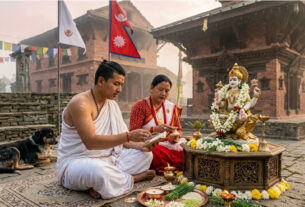
Nepal has a unique tradition of ancestor reverence. Festivals like Gokarna Aunsi, Mata Tirtha Aunsi, and Sorha Shraddha reflect the cultural observance of Pitra duties. True Pitra worship is service to living elders, not costly rituals alone.
9. Conclusion: Journey from Dosh to Moksha
Pitra Dosh is not a tool of fear. It is a profound topic connected to the roots of existence. With devotion, service, and remembrance, even the strongest dosh can transform into blessings.
“He who respects parents, protects his lineage, serves the helpless, and offers even a handful of water to ancestors once a year—his horoscope, however afflicted, is blessed by Vishnu and the Pitris, turning obstacles into Raj Yoga.”
Om Shanti Shanti Shanti (Pitra Devo Bhava