Introduction: The Weaving of Belief and Practice
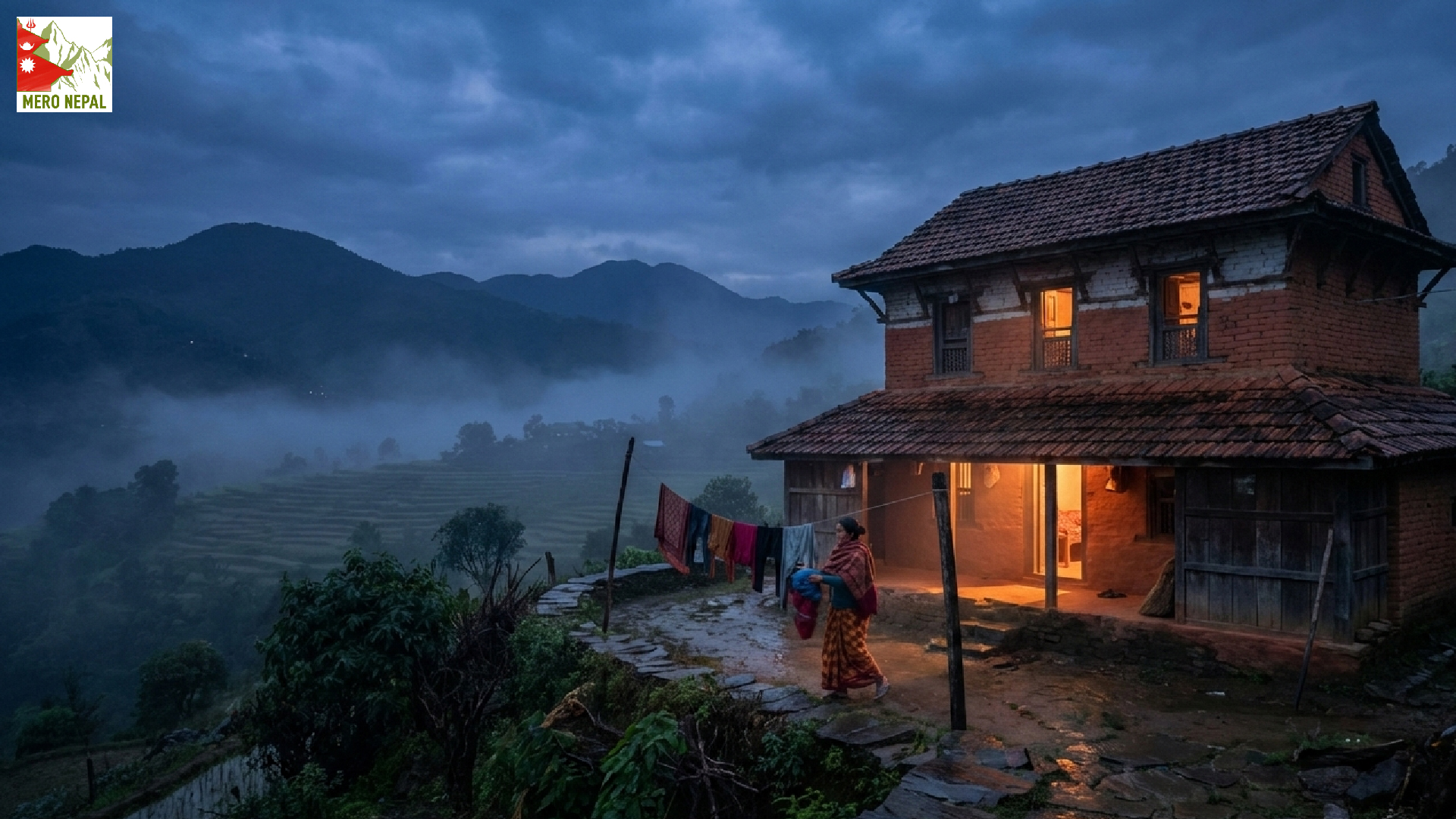
In Nepali society, the habit of bringing in clothes dried outside before dusk is more than just a simple household chore; it is a deep-seated cultural ritual. This tradition is a sophisticated practice of protection woven from two different but complementary threads: first, a rich tapestry of folk beliefs regarding nighttime dangers, and second, a reservoir of practical, time-tested knowledge about health and environmental realities.
This report argues that the Nepali tradition of not leaving clothes outside overnight is a powerful example of how folk beliefs function as pre-scientific public health guidelines. Supernatural stories serve as a culturally resonant framework for enforcing practical hygiene and safety measures, specifically focusing on the protection of the community’s most vulnerable members. This report first explores the supernatural worldview behind this practice, then analyzes its scientific foundations, and finally integrates these two perspectives to highlight the lasting significance of this tradition.
The Invisible World After Dark: Supernatural Threats in Nepali Folk Beliefs
This section presents a detailed ethnography (anthropological description) of the folk beliefs that provide the primary cultural justification for this practice. It analyzes how clothing is viewed not merely as an object but as an integral part of an individual, making it a medium for supernatural influence.
The Principle of Sensitivity: Children and the “Weak Minded”
In Nepali culture, having a “weak mind” (man kamjor) is a holistic concept encompassing emotional vulnerability, physical illness, and spiritual sensitivity. It is believed that children—due to their purity and developing life force—and individuals with a “weak mind”—due to their fragile spiritual immunity—are particularly sensitive to the influence of evil or restless spirits active at night. Their personal items, especially clothes carrying their scent and essence, are considered direct gateways for these spirits to cause harm.
This cultural identification is not based on arbitrary belief. Considering children and the “weak-minded” as most vulnerable aligns closely with biomedical understanding. According to medical science, children (with developing immune systems) and those who are ill or stressed (with weakened immunity) are physically more susceptible to actual health risks associated with damp, contaminated clothing, such as fungal infections, bacterial diseases, and allergic reactions. Thus, the spiritual caution described in folk belief is actually a targeted public health measure for at-risk populations. The folk classification of “weak mind” is a culturally specific way of describing this state of physical and psychological vulnerability.
Factors of the Night: Classification of Threats
This section details specific supernatural forces believed to be active after dusk and their alleged interactions with human belongings.
Witchcraft/Dyan’s Touch and Spells
Particularly in the Terai region, there is a deep-seated belief that witches (Boksi/Dyan) are most active at night and during special times like Dashain. Clothing is considered a primary material for “Tunamuna” (evil spells). It is believed that by obtaining someone’s clothes, a witch can cast illness, cause misfortune, or gain control over them. Therefore, bringing clothes in is a direct protective measure against this magical threat.
The Sorrow of Female Spirits: Kichkandi and Dagin
Kichkandi: Described as the suffering spirit of a woman who died unjustly or tragically. Her presence is associated with bridges and cliffs. Contact with her or objects she has touched is believed to cause chronic illnesses. Clothes left outside are considered vulnerable to her tragic and contaminating touch.
Dagin: A mysterious female ghost, often seen in white clothes with long hair, who wanders in solitary places at night to lure or terrify victims. Her presence is marked by sudden, unnatural cold and gusts of wind. It is believed this “cold” can transfer to any object around her, and wearing clothes filled with this energy can cause fear, illness, and nightmares.
Spirits of Death and Decay: Masan and Pishacha
These spirits are associated with cremation grounds and the process of death. A Masan or Pishacha is an evil spirit symbolizing decay and negative energy. The belief is that these spirits roam outside their dwellings at night. Clothing, especially if damp, is seen as an ideal medium for their dark, death-related energy to cling to. Bringing such clothes into the home is seen as inviting serious illness and terrible omens into the sacred space of the house.
General Ghosts (Bhut-Pret)
This category includes general restless spirits of the deceased (Bhut-Pret) and other unique spirits like the Bhakunde Bhut (a small, spherical ghost). While not always explicitly evil, their nature is chaotic and contrary to the sanctity of the home. They are believed to cling to or temporarily inhabit clothes left outside, causing psychological stress (fear, nightmares) and general illness, especially in children.
Clothing as a Spiritual Medium: An Anthropological Perspective
The deep fear behind this practice isn’t just about an object becoming contaminated; it’s about a part of the person being left vulnerable. In the Nepali worldview, clothing is not a separate, inanimate object but an intimate extension of the wearer, filled with their essence (scent, sweat, energy).
In many belief systems worldwide, objects that have been in contact with a person can be used to affect that person from a distance. The belief that a witch uses personal items for spells supports this directly. Thus, leaving clothes outside at night is symbolically equivalent to leaving a vulnerable part of one’s body or soul open to the uncontrolled, dangerous, supernatural realm of the night. The act of bringing clothes in is a ritual of reintegration and protection, gathering all parts of oneself back into the safe, sacred space of the home before the boundaries between worlds thin.
Summary of Supernatural Threats in Nepali Folklore
| Name of Supernatural Power (Nepali / English) | Key Characteristics | Interaction with Clothes / People |
| Witch / Boksi / Dyan (बोक्सी / डायन) | A living person with evil magical powers (Vidya). Especially active during special times (e.g., Dashain). | Can steal or enchant clothes for use in “Tunamuna” (evil spells) to cause illness, misfortune, or control. |
| Kichkandi (किचकन्डी) | The suffering spirit of a woman who died unjustly or tragically. Wanders in solitary places like bridges and cliffs. | Her touch or proximity can fill clothes with negative energy, making the wearer ill for a long time. |
| Dagin (दागिना) | A female ghost with white clothes and long hair who appears in solitary places at night to lure or terrify victims. | Her presence can leave a “cold” or negative spiritual residue on objects left outside, causing fear and illness. |
| Masan / Pishacha (मसान / पिशाच) | Demons or spirits associated with cremation grounds and death. They survive on life force. | Can attach their dark, death-related energy to clothes, bringing serious illness or bad omens into the home. |
| Bhut-Pret (भूत-प्रेत) | General restless spirits of the deceased who wander at night. | Can temporarily inhabit or cling to clothes, causing nightmares, fear, and illness in the wearer, especially children. |
The Logic of Caution: Environmental and Health-Related Foundations
This section focuses on scientific, environmental, and health-related arguments, providing a parallel, empirical justification for the tradition. It shows how the outcomes predicted by folk beliefs (illness, discomfort) align with the results of scientifically observable phenomena.
Nepali Night: Climate and Environment
Specific environmental factors in Nepal make leaving clothes outside overnight impractical and unhealthy.
Humidity and Dew: Research clearly states that humidity levels rise dramatically at night. In many parts of Nepal (from the Terai plains to the mid-hills), high nocturnal humidity and heavy dew prevent clothes from drying and often make them damper than before. This is directly contrary to the purpose of putting clothes out to dry.
Unpredictable Weather: Nepal’s geography leads to sudden local weather changes, including nighttime rain or storms that can ruin freshly washed laundry.
Microscopic Threats: Invisible Pollutants
This subsection focuses on health risks from microorganisms that thrive in damp conditions.
Mold and Bacteria: High humidity creates a breeding ground for bacteria and mold. This leads to bad odors, fabric decay, and more seriously, skin irritation, rashes, and respiratory issues, especially for those with sensitive skin or conditions like eczema.
Pollen and Allergies: Clothes, especially damp ones, act as effective traps for airborne allergens. Research shows that airborne pollen can cling to damp cloth. This is a significant issue in Nepal’s diverse ecosystems. Bringing pollen-laden clothes or bedding inside can trigger or worsen hay fever, asthma, and other allergic reactions, manifesting as sneezing and itchy skin.
Macro-level Risks: Pollutants and Creatures.
This covers larger-scale environmental hazards.
Air Pollution: In urban areas like Kathmandu, air quality is often poor. Clothes left out overnight can absorb airborne pollutants, smoke, and particles from traffic and industry. These particles can cause skin irritation and are harmful when inhaled, especially for children.
Insects and Animals: Night brings out various creatures. In the Terai, this includes disease-carrying mosquitoes (Dengue, Japanese Encephalitis) which are most active at dawn and dusk. Clothes can also be soiled by insects, bird droppings, or other nocturnal animals.
Synthesis: The Convergence of Folk Belief and Practicality
This critical section synthesizes the previous two arguments, showing that folk beliefs and practical explanations are not mutually exclusive but are actually deeply interconnected.
Folk Belief as a Pre-Scientific Public Health Guideline
This analysis clearly presents the report’s central argument. It argues that supernatural stories are not just “stories” but a highly effective, culturally established public health communication strateg
This metaphorical translation of risk draws direct parallels:
The fear of a witch’s spell motivates people to prevent “contamination” by real-world pollutants and microorganisms.
The “unnatural cold” left by a Dagin is a perfect metaphor for the unhealthy dampness of clothes left in high humidity.
The “chronic illness” caused by a Kichkandi serves as a memorable warning for real risks like long-term allergic reactions or skin infections from mold- and pollen-laden fabric.
A story of a spirit is more memorable, emotionally resonant, and easier to pass down through generations than a complex scientific explanation of humidity and microbial growth. Folk belief provides a simple, actionable rule—”bring the clothes in”—which effectively mitigates a wide range of complex and often invisible risks.
Social and Psychological Order of the Home
This subsection explores the broader social function of the ritual.
Defining Boundaries: The daily act of bringing in clothes at dusk reinforces a fundamental symbolic boundary between the home (a place of order, safety, and control) and the outside (a place of chaos, danger, and the unknown), especially after dark.
Reinforcing Care and Responsibility: This ritual is established as a tangible expression of parental care and domestic responsibility. It is a daily task that demonstrates commitment to protecting the health and well-being of the family, especially its most vulnerable members. It reinforces social roles and establishes the home as a sacred sanctuary.
Conclusion: A Lasting Tradition in a Changing Nepal
To summarize the main findings of this report, the tradition of bringing in clothes at night is not a simple superstition but a sophisticated cultural adaptation. It is a practice where a rich folk worldview and keen practical observation meet to create an effective strategy for ensuring family well-being.
Reflecting on the continuity of this tradition in contemporary Nepal, while modern education provides scientific explanations for risks, the framework of folk belief often remains a powerful cultural foundation. This practice persists because it remains effective on both practical and symbolic levels, protecting the body from tangible harm while also providing a sense of spiritual safety and order in a complex world.
Finally, this seemingly simple household rule offers a deep insight into the Nepali worldview—a holistic approach where physical health, peace of mind, and spiritual safety are all integrally connected and must be protected together.