

1. Invocation and Introduction
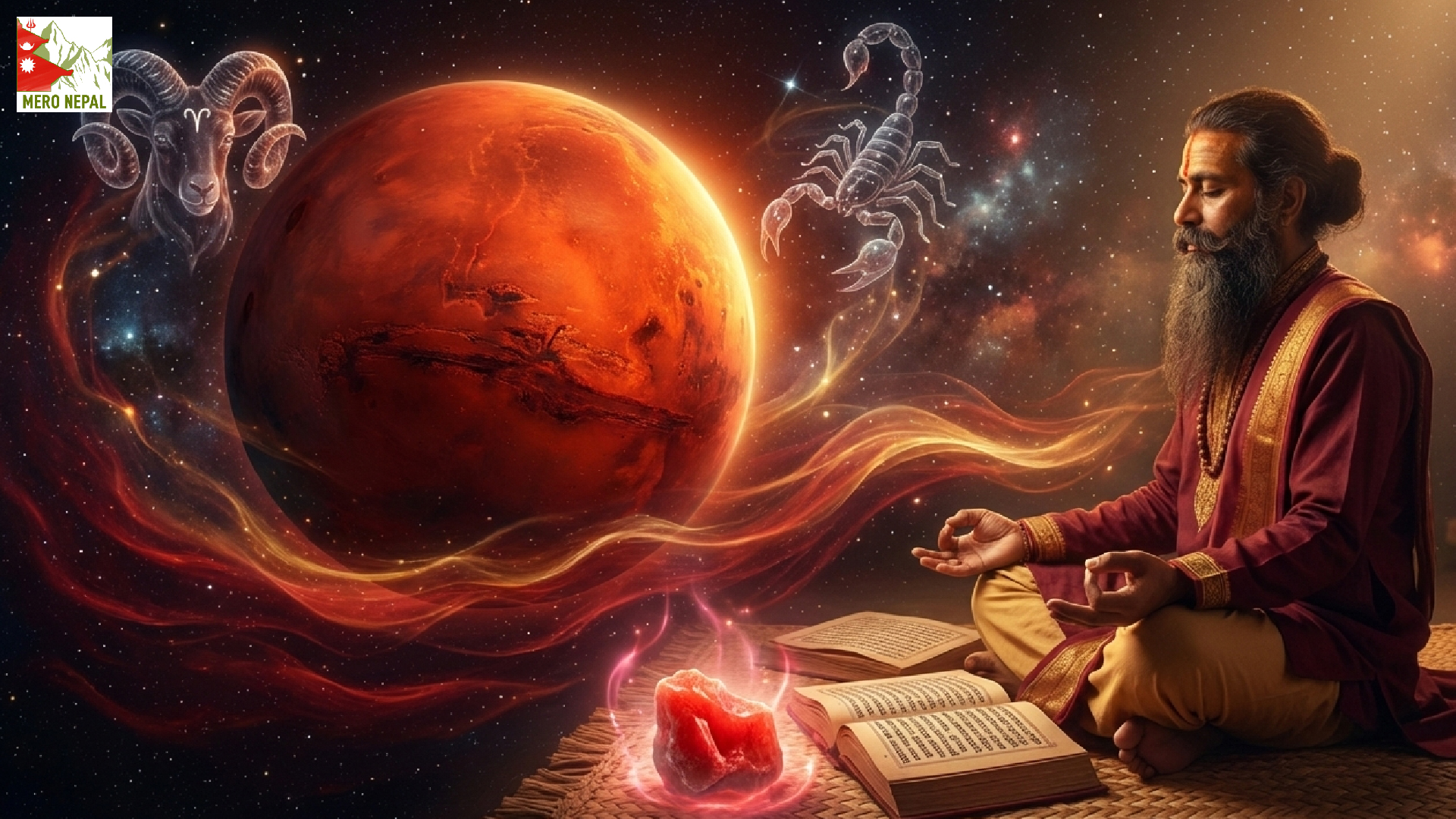
Astrology is the subtle study of the interrelationship between celestial bodies and human life. In Nepali society—shaped by unique geography, a history of valor, and deep-rooted ritual traditions—the influence of Mars (Mangala) holds exceptional philosophical and practical significance. Regarded as the commander of the solar system, Mars signifies power, courage, land, action, and disciplined force. It is appropriate to begin this extensive study with traditional invocations that reveal both the physical and metaphysical nature of Mars.
Invocation (Mangala Stotra)
Dharanīgarbhasambhūtaṁ vidyutkāntisamaprabham |
Kumāraṁ śaktihastaṁ ca Maṅgalaṁ praṇamāmyaham ||
Meaning: I bow to Mars, born of the Earth, radiant like lightning, eternally youthful, and bearing divine power in his hands.
Another classical verse highlights the dual—benefic and malefic—nature of Mars:
Ṛṇahartā dṛṣṭikartā rogakṛd roganāśanaḥ |
Vidyutprabho vraṇakaraḥ kāmado dhanahṛt Kujaḥ ||
Meaning: Mars removes debts and grants vision; he causes and cures disease, gives wounds and healing, fulfills desires, and both grants and withholds wealth.
1.1 Essential Nature of Mars
In Nepali astrology, Mars is known as Kuja or Bhauma, meaning “born of the Earth.” If the Sun is the king of the planetary council, Mars is the chief commander. Mars converts intention into action, fuels vitality, and enables resistance against obstacles. It is a fire-element planet, tamasic in quality, red in color, masculine in nature, and associated with the southern direction. Although categorized as a natural malefic, Mars ultimately upholds discipline, righteousness, and protection through strict consequences.
2. Mars and the Nepali Landscape
Astrological results must be judged by desa (place), kāla (time), and pātra (individual).
2.1 Geographic Context
Nepal’s mountainous terrain, rocky soil, and seismic activity directly resonate with Mars, the significator of land, minerals, and rugged geography. Physical endurance, stamina, and land ownership—highly valued in Nepali society—reflect strong Martian influence. Natural disasters such as landslides and earthquakes are also interpreted through Mars’ relationship with the Earth element.
2.2 Cultural and Martial Identity
The global identity of the “Brave Gorkhali” is a living expression of Mars. Courage, fearlessness, military skill, and the symbolic khukuri align precisely with Martian attributes. From an astrological viewpoint, Nepal’s national horoscope is often considered Mars-dominant, explaining its historical independence and martial legacy.
3. Significations of Mars
3.1 Physical and Medical Significations
Mars governs bone marrow and blood. It controls red blood cell production, body heat, digestion (pitta), muscular strength, surgery, wounds, burns, accidents, and high blood pressure. Weak Mars may result in anemia or inflammatory disorders.
3.2 Social and Familial Significations
Mars signifies younger siblings, courage, property disputes, enemies, debts, and litigation. Strong Mars defeats enemies; afflicted Mars entangles one in conflict and loans.
3.3 Material and Professional Domains
Land, construction, engineering, machinery, electricity, mining, military service, policing, athletics, and surgery all fall under Mars’ domain.
3.4 Psychological Dimensions
Mars grants initiative, willpower, leadership, and logical assertiveness. Negatively, it manifests as anger, impulsiveness, aggression, and revenge.
4. Zodiacal and Nakshatra Placement
Mars rules Aries and Scorpio, is exalted in Capricorn (28°), and debilitated in Cancer (28°). Exalted Mars produces disciplined leadership; debilitated Mars transforms courage into emotional instability.
Mars rules the nakshatras Mrigashira, Chitra, and Dhanishtha, influencing research, construction, wealth, rhythm, and authority.
5. Mars in the Twelve Houses (Summary)
Mars produces results according to its house placement, modified by aspects and conjunctions. In upachaya houses (3rd, 6th, 10th, 11th), Mars generally performs strongly. In sensitive houses such as the 7th, 8th, and 12th, careful evaluation is required due to Mangalik considerations.
(Detailed house-wise results follow classical principles and are interpreted contextually rather than absolutely.)
6. Conjunctions of Mars
-
Mars–Sun: Authority, leadership, government power; excessive proximity forms Angaraka Yoga.
-
Mars–Moon: Chandra–Mangala Yoga, a strong wealth-producing combination.
-
Mars–Mercury: Sharp intellect, debate, technical skills; potential verbal conflict.
-
Mars–Jupiter: Guru–Mangala Yoga, disciplined power guided by ethics.
-
Mars–Venus: Passion, creativity, attraction; risk of indulgence.
-
Mars–Saturn: Conflict and endurance; success through struggle.
-
Mars–Rahu/Ketu: Explosive, unconventional, accident-prone yet politically potent combinations.
7. Special Yogas
7.1 Ruchaka Mahapurusha Yoga
Formed when Mars occupies a kendra in its own or exalted sign, producing fearless leaders, warriors, administrators, and landowners.
7.2 Mangalik Dosha: Myth and Reality
Mangalik Dosha arises when Mars occupies specific houses. Its effects are often exaggerated; cancellation occurs through age, mutual Mangalik matching, exaltation, or balancing planetary influences.
8. Remedies for Mars
-
Gemstone: Red Coral (6–10 carats) set in copper or gold.
-
Deities: Ganesha, Kartikeya, Hanuman, Bhairava.
-
Mantras: Om Kraam Kreem Kraum Sah Bhaumaya Namah (108 times).
-
Charity: Red clothes, lentils, copper, jaggery on Tuesdays.
-
Practical Measures: Blood donation, discipline, respectful sibling relations.
9. Conclusion
From a Nepali astrological perspective, Mars is not merely a planet but the vital force that sustains struggle, courage, and material stability. Nepal’s geography, history, and social temperament mirror Martian principles. A well-placed Mars grants resilience and prosperity; an uncontrolled Mars invites conflict and destruction. Through awareness, discipline, and proper remedies, Mars ultimately bestows mangalam—constructive strength and purposeful action.
“Through sincere worship of Mars, all planetary afflictions are surely destroyed.”


