Part 1: Introduction – Three Lights Shining in the Darkness of Aunsi
Kushe Aunsi falls on the Krishna Paksha (waning moon) of the month of Bhadra. On this day, the absence of the moon casts a deep darkness over the earth. Yet, in the sky of Nepali culture and tradition, this day is not an ordinary Aunsi; it is a special festival illuminated by three powerful lights. The darkness of this day is pierced by three symbolic flames: first, the light of the sacred “Kusha” grass, representing nature’s purity; second, the light of profound reverence and respect for living fathers, regarded as living deities; and third, the light of memory offered in honor of departed ancestors, seeking their peace and liberation.
This festival, known variously as Kushe Aunsi, Father’s Day (Bubako Mukh Herne Din), or Gokarna Aunsi, is not merely the Nepali version of the Western “Father’s Day.” It is far deeper, meaningful, and multidimensional. The festival binds the individual, family, lineage, and nature together in an inseparable bond. It reflects a powerful dimension of Hindu philosophy, where personal (relationship with the father), ancestral (continuity of forefathers), and cosmic (purity of nature) aspects are intrinsically connected. This is not just a festival—it is a holistic recognition of the cyclical relationship between life, death, and nature.
How is it that three seemingly distinct practices—bringing sacred grass into the home, worshiping the living father, and performing rites for the departed fathers—are so beautifully and logically intertwined on the same day? Exploring this mystery reveals the essence of the festival.
Part 2: Many Names, One Essence – Literal and Cultural Significance
To understand any festival deeply, it is important to explore the meanings of its various names. The different names of Kushe Aunsi are not mere synonyms; each name highlights a specific and important aspect of the festival. They also reflect the historical development of the festival and the priorities assigned by different communities.
Kushe Aunsi:
This is the oldest and most fundamental name of the festival, centered around the sacred plant called Kusha. It points to the Vedic and nature-based roots of the festival. In traditional Hindu rituals, Kusha grass is considered essential for all sacred ceremonies, from worship of deities to offerings for ancestors. On this day, the sacred Kusha is ceremonially cut with mantras and brought into the home, representing purity and continuity of Vedic rituals.
Father’s Day (Bubako Mukh Herne Din):
This is the most popular, emotional, and socially recognized name of the festival. It places the father at the center of devotion, love, and family bonds. “Mukh Herne” (literally “seeing the face”) does not just mean physically looking at the father’s face—it carries a deep cultural meaning: acknowledging, honoring, and expressing gratitude for his contributions. On this day, children offer sweets, clothes, and other gifts, bow at their father’s feet, and receive his blessings, reinforcing familial bonds.
Gokarna Aunsi:
This name emphasizes the geographical and pilgrimage aspects of the festival. Particularly in and around the Kathmandu Valley, the festival is popularly known by this name. It highlights the significance of performing rites, offerings, and Pindadaan at the Gokarneshwor Mahadev pilgrimage site for the peace and liberation of departed fathers. Large fairs and gatherings at Gokarna give the festival its name.
Pitru Aunsi / Pitru Tirth Aunsi:
These names explicitly stress that the day is dedicated to remembering and honoring ancestors. According to Hindu scriptures, the Krishna Paksha Aunsi of Bhadra is especially auspicious for performing ancestor-related rites. These names emphasize the philosophical dimension of lineage, Shraddha rituals, and the duty toward forefathers.
The coexistence of these various names demonstrates that the festival is not limited to a single form or interpretation. It allows different individuals and communities to observe the day according to their own circumstances, priorities, and cultural preferences.
Name | Literal Meaning | Core Concept/Significance |
|---|---|---|
Kushe Aunsi | The Aunsi for Collecting Kusha Grass | Nature, Purity, and Continuity of Vedic Rituals |
Father’s Day (Bubako Mukh Herne Din) | The Day to See (Honor) One’s Father | Family Bonds, Reverence for Fathers, and Gratitude |
Gokarna Aunsi | The Aunsi Associated with the Gokarna Pilgrimage Site | Remembrance of Ancestors, Pilgrimage, and Aspiration for Liberation |
Pitri Aunsi / Ancestors’ Day | The Aunsi Dedicated to Ancestors | Lineage, Shraddha Rituals, and Duty to Ancestors |
Part 3: Kusha – From Ordinary Grass to the Form of Vishnu
At the heart of Kushe Aunsi lies Kusha grass, which is far more than just an ordinary plant. In eternal Hindu philosophy, it represents a unique confluence of faith, science, and tradition. Its significance can be understood from three perspectives: mythological, religious, and scientific.
Subsection 3.1: Mythological Origin – Divine Fragment and Curse
Various mythological texts narrate fascinating stories about the origin of Kusha, which elevate it to a divine status:
The Varaha Avatar: According to a popular belief, when Lord Vishnu took the Varaha (boar) incarnation to rescue the submerged Earth, the hairs that fell from His body while shaking off water grew into Kusha on Earth. Hence, Kusha is considered a part of Lord Vishnu himself.
The Curse of Vrinda: Another story from the Shwastani Vrat Katha describes that Lord Vishnu had to deceive Vrinda, the devoted wife of the demon Jalandhar, to defeat him. Upon realizing the deception, Vrinda cursed Vishnu to take the form of grass, bushes, trees, and stones. Thus, Vishnu assumed the form of Kusha grass.
Churning of the Ocean (Samudra Manthan): Some Puranas narrate that during the Samudra Manthan, a few drops of nectar fell on Kusha, granting it the power to purify and sanctify, making it spiritually potent.
Valmiki’s Creation: In the Ramayana, Maharishi Valmiki is said to have created another child from Kusha grass to comfort Sita in the absence of her son Lava. This child was named “Kusha,” further enhancing the sacred association of the grass.
These stories elevate Kusha from a simple plant to a direct symbol of Lord Vishnu, ensuring its preservation and religious usage across generations.
Subsection 3.2: Religious Necessity – From Birth to Death
In Hindu rituals, no ceremony is considered complete without Kusha. Its presence is mandatory in rites from birth to death:
Pavitra (Ring): During any religious or ancestral ceremony, a ring made of Kusha grass, called Pavitra, is traditionally worn on the right hand’s finger. For deity worship, it is worn on the little finger; for ancestral rites, on the ring finger. Without this sacred ring, it is believed that the rituals do not yield their full spiritual benefits.
Asana and Purification: While performing meditation, chanting, or worship, sitting on a Kusha mat (Kusha Asana) is prescribed. It is believed to help retain the energy generated from spiritual practices. Similarly, Kusha is used to purify water for rituals or for ceremonial baths (Abhisheka).
Longevity of Kusha: According to scriptures, Kusha cut properly on Kushe Aunsi remains potent and usable for a full year, and if the day falls on a Monday (Sombare Aunsi), it remains sacred for up to 12 years.
Subsection 3.3: Scientific and Logical Perspective – Wisdom Hidden in Tradition
The sacred significance of Kusha is not merely superstition; it also has deep scientific and logical foundations:
Radiation Absorption: Modern studies indicate that Kusha can absorb or neutralize negative energy and radiation. In one experiment, Kusha placed between sources of radiation reduced nearly 60% of the harmful radiation. This explains why Kusha is used to purify food during eclipses and in meditation, where Kusha rings and mats are employed to protect against harmful environmental waves.
Ayurvedic and Medicinal Properties: In Ayurveda, Kusha is considered a valuable medicinal plant. Its roots and leaves are used to treat ailments such as high blood pressure, kidney stones, urinary disorders, blood disorders, and skin problems. Sitting on a Kusha mat (Gundri) is believed to benefit patients with hypertension.
Origin of the Word “Kushal” (Skilled): The sharp and pointed nature of Kusha leaves was historically used in Gurukuls (traditional schools) during exams. Students were made to collect Kusha without injuring their hands; those who could do so skillfully were called “Kushal,” symbolizing precision, skill, and care.
Thus, Kusha serves as an exemplary integration of knowledge in Vedic tradition. Mythological stories transmit its scientific significance in a culturally memorable way, religious practices ensure its medicinal benefits reach every generation, and faith and logic coexist harmoniously without conflict.
Part 4: “Pitru Devo Bhava” – Honoring Fathers and the Philosophy of Ancestral Duty
The most emotional and socially significant aspect of Kushe Aunsi is “Father’s Day” (Bubako Mukh Herne Din). This day is not merely a celebration; it carries a profound philosophical concept rooted in Sanatan Dharma, known as Pitru-Rin (ancestral debt).
Subsection 4.1: Pitru-Rin – An Innate Duty
According to Sanatan Hindu philosophy, every human is born carrying three primary debts:
Deva Rin – debt to the deities
Rishi Rin – debt to gurus and sages
Pitru-Rin – debt to one’s parents and ancestors
Pitru-Rin signifies the moral and spiritual obligation to repay the gift of life, body, upbringing, and lineage bestowed by one’s parents and ancestors. They gave us birth, nurtured us, and made us capable of standing in this world. To repay this debt, scriptures prescribe that children serve and honor their living parents and perform Shraddha and Tarpan for the departed ancestors. The tradition of “seeing one’s father’s face” is a simple and practical manifestation of this profound philosophical principle. It translates complex religious concepts into acts of love and respect, making them accessible and meaningful to all.
Subsection 4.2: Honoring Living Fathers – The “Face-Seeking” Tradition
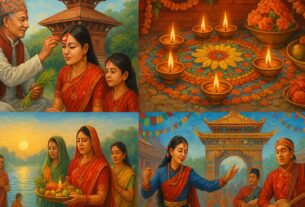
On this day, children worship and honor their fathers as living deities. They offer favorite foods, sweets, fruits, and new clothes as gifts. Sons place their foreheads on their father’s feet in reverence, while daughters touch them with their hands, expressing respect and receiving blessings. This tradition recognizes the father as the pillar, protector, and teacher of the family.
With modernization, the way the festival is observed has also evolved. Children living abroad or away for work or studies may not be physically present, but they can express love and respect through phone calls, video calls, or sending gifts and money online. These modern methods help bridge physical distance while strengthening emotional bonds.
Subsection 4.3: The Glory of Fathers – Scriptural Verses and Poetry
The importance of fathers is highly esteemed in Hindu scriptures. Several powerful Sanskrit shlokas describe the father’s significance:
“Pita Swargah Pita Dharma Pita Hi Paramam Tapah; Pitari Pretimapanne Priyante Sarvadevatah”
Meaning: The father is heaven, the father is dharma, and the father is supreme penance. When the father is pleased, all deities are pleased.
This shloka emphasizes that a father’s contentment is the highest dharma and the pathway to divine blessings.
“Janakascho Paneta Cha Yascha Vidyam Prayacchati; Annadata Bhayatrata Panchai-te Pitarah Smritah”
Meaning: Those who give birth, perform Upanayana (sacred thread ceremony), impart knowledge, provide food, and protect from danger are considered equal to a father.
This verse elevates the concept of a father beyond mere biological ties, recognizing him as a protector and guide. Reflecting on such selfless dedication, poet Chandra Gurung writes in his poem “My Father’s Face”:
“Carrying the burdens of every sorrow, hiding them, and returning with little seeds of joy to illuminate the home and courtyard.”
These verses and poems portray the father not just as the head of the family but as a selfless guide shaping the future of his children.
Part 5: Gokarneshwar – Pilgrimage of the North and Mythological Narrative
For those whose fathers are alive, Kushe Aunsi is a day of celebration. For those whose fathers have passed away, it is a sacred occasion for remembrance, reverence, and seeking liberation. For this purpose, one of Nepal’s most important pilgrimage sites is Gokarneshwar.
Subsection 5.1: Significance of the Pilgrimage – Merit of the Northern Gaya
Located on the banks of the sacred Bagmati River in northeastern Kathmandu, Gokarneshwar Mahadev Temple is renowned for performing Pitru-Shraddha. According to religious belief, performing Shraddha, Tarpan, and Pindadaan in the name of ancestors here is equivalent in merit to performing the same rituals at the famous pilgrimage of Gaya in India. Hence, Gokarneshwar is also called “Uttara Gaya” (Northern Gaya). On this day, thousands of devotees gather here to pray for the peace of their departed fathers’ souls.
Subsection 5.2: The Deer-Form Shiva and the Establishment of Gokarneshwar
The origin of Gokarneshwar is linked to Lord Shiva. According to myth, once Lord Shiva took the form of a deer and roamed the Shleshmantak forest (present-day Pashupati area). When the gods tried to capture him, Brahma caught the deer’s horn, which broke into three pieces. Following Shiva’s command, Brahma installed one piece at this location, which later became known as Gokarneshwar Mahadev.
The literal meaning of “Gokarna” is “cow’s ear.” Another legend connects this name to Ravana and the Atmalinga: when Lord Ganesha tricked Ravana, leaving only the cow’s ear portion above ground, the location became sacred.
Subsection 5.3: The Story of King Vrishakarna and Prince Gokarna – The Origin of Father’s Day
Behind the tradition of performing Shraddha at Gokarna on Kushe Aunsi lies a poignant and meaningful story. In ancient times, King Vrishakarna ruled this region. His son, Prince Gokarna, often behaved poorly, leading to frequent disputes between father and son. Frustrated with his strained relationship, the prince left home. Later, the king passed away in the absence of his son, and with no one to perform his last rites, his spirit became restless.
Years later, Prince Gokarna encountered his father’s suffering spirit in Yamapuri. Overcome with remorse, he returned to Gokarna to perform the proper Shraddha, Tarpan, and Pindadaan rituals for his father’s soul. The day he performed these rites was Bhadra Krishna Aunsi, and it is said that his father’s soul attained liberation that same day.
Since then, a belief has been established that performing Pitru Shraddha at Gokarna on Bhadra Krishna Aunsi grants ancestors moksha (liberation). This legend transformed a simple geographical site into a sacred pilgrimage, keeping the tradition of ancestral worship alive for thousands of years.
Subsection 5.4: Shraddha Rituals – The Process of Honoring Ancestors
Shraddha means performing acts with devotion. It is a Vedic process to honor and express gratitude toward deceased ancestors. The main rituals performed at Gokarna include:
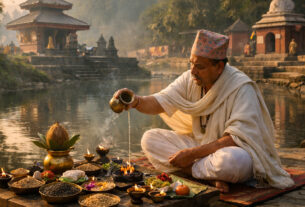
Tarpan: Offering water with sesame seeds and Kusha grass to ancestors while chanting mantras. It is believed that this quenches the thirst of the departed souls.
Pindadaan: Offering a ball (pind) made of barley flour, sesame, ghee, and honey as a symbolic representation of ancestors. It is believed to satiate their hunger and provide them with energy.
Sidadan: After completing Shraddha, donations of rice, lentils, salt, vegetables, and Dakshina (monetary offerings) are given to Brahmins. This is believed to reach the ancestors and fulfill the obligations of Pitru-Rin.
These rituals symbolically repay ancestral debt and ensure the continuity of lineage.
Part 6: Conclusion – A Confluence of Tradition, Relationships, and Science
Kushe Aunsi is not merely a one-day festival; it embodies the living essence of Nepali culture and Sanatan philosophy. It stands on three significant pillars:
Kusha Grass – representing nature and our connection with the cosmos
Father – representing family and our relationship with the present
Ancestors – representing lineage and our bond with the past
By bringing these three aspects together in a single day, Kushe Aunsi celebrates the wholeness of life.
The festival is a unique confluence of faith, duty, emotion, and logic. The scientific benefits hidden in the use of Kusha highlight the logical aspect of tradition, while the philosophy of Pitru-Rin awakens our sense of responsibility. Love and respect toward fathers deepen emotional bonds, and the mythological narratives of Gokarneshwar strengthen faith.
In today’s fast-paced world, where we feel disconnected from our roots, festivals like Kushe Aunsi help us reconnect with our identity and traditions. They reinforce intergenerational bonds and teach respect for nature. Modern adaptations, such as seeing one’s father through video calls, reflect the festival’s evolution while preserving its core values.
The central message of Kushe Aunsi—gratitude, respect, and continuity—is universal and timeless. Therefore, Kushe Aunsi is not merely a relic of the past; it is a cultural treasure that gives meaning to the present and guidance for the future, one that we should preserve with pride.
Explore More Services
Download Nepal’s Best Astrology App: meronepal.app