

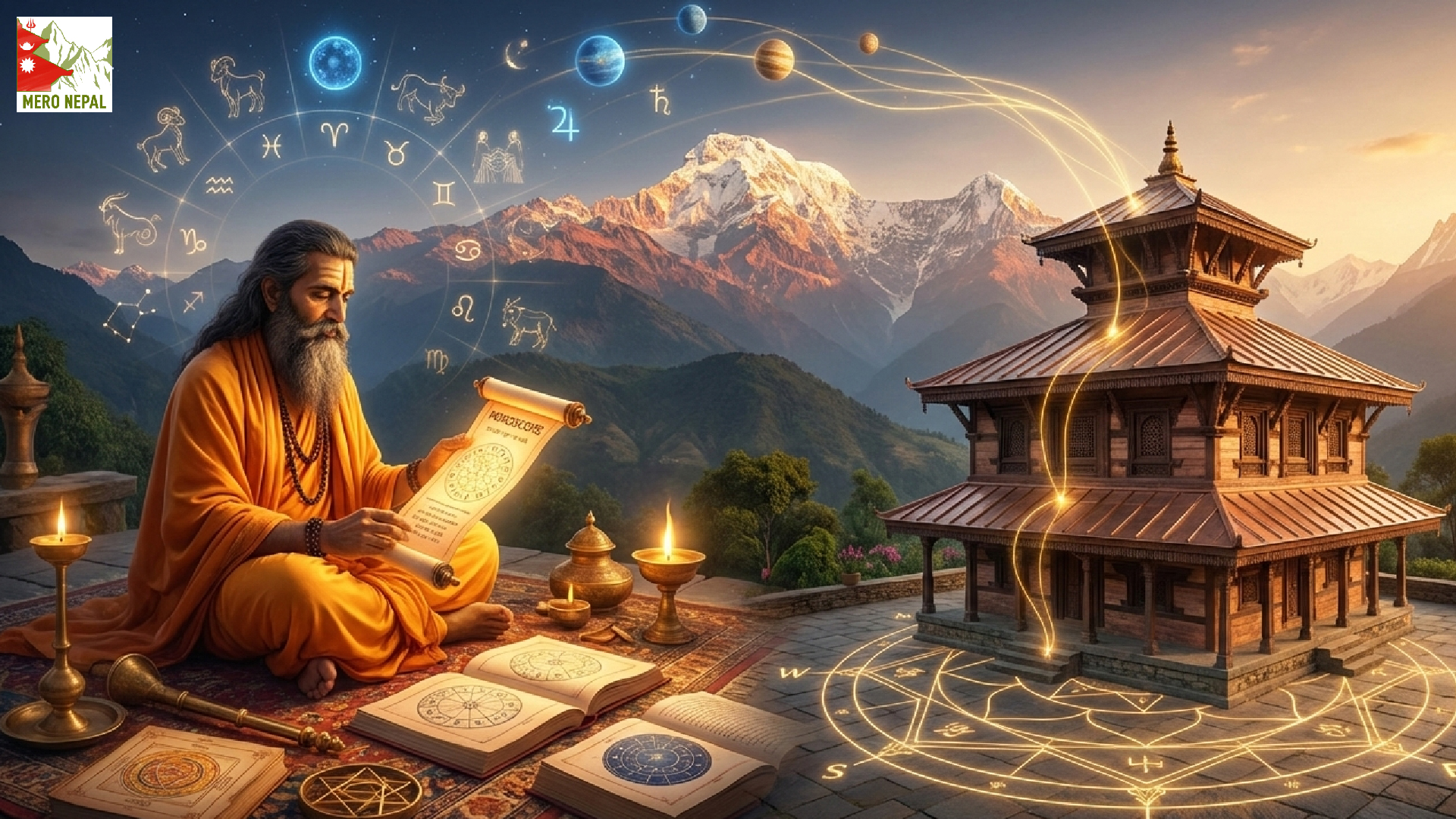
1. Introduction: The Union of Time and Space
In the Vedic tradition, human existence is governed by two fundamental dimensions: Time (Kala) and Space (Desha). Astrology (Jyotish) is the master of Time, while Vastu Shastra is the master of Space. While modern perspectives often separate them—viewing Vastu as a “logical science” and Astrology as a “predictive art”—this article demonstrates that they are two sides of the same coin. One diagnoses the internal karmic journey, while the other harmonizes the external environment.
2. Astrology: The Science of Cosmic Light
2.1 Etymology and Definition
The word Jyotish is derived from the Sanskrit ‘Jyoti’ (Light) and ‘Shastra’ (Science). It is the “Science of Light” that illuminates the path of human life. It studies the influence of celestial bodies—planets (Grahas), zodiac signs (Rashis), and constellations (Nakshatras)—on human existence.
2.2 The “Eyes of the Veda” (Veda Chakshu)
Astrology is classified as a Vedanga (a limb of the Veda). It is called the “Eyes of the Veda” because:
-
Illumination: Just as eyes reveal the physical world, Jyotish reveals the unseen “Karmic path” of an individual.
-
Ritual Precision: Its primary Vedic purpose was to determine the precise Muhurta (auspicious time) for performing sacred rituals. The Vedanga Jyotisha, attributed to Sage Lagadha, remains the foundational text for these astronomical calculations.
2.3 The Philosophy of Karma
Astrology operates on the Law of Karma. A birth chart (Kundali) is essentially a “snapshot” of the universe at the moment of birth, serving as a map of an individual’s Prarabdha (past actions). It predicts When specific energies will manifest through planetary cycles (Dashas) and transits (Gochar).
3. Vastu Shastra: The Science of Sacred Space
3.1 Definition and Origin
Vastu comes from the root ‘vas’, meaning “to dwell.” It is the science of architecture and residence. Unlike Astrology, Vastu is classified as an Upaveda (a supplementary Veda) of the Atharva Veda, specifically under the category of Sthapatya Veda.
3.2 Theoretical Science vs. Applied Engineering
The scriptures distinguish between the two:
-
Vastu Shastra: The philosophical and theoretical science of energy and direction.
-
Sthapatya Veda: The practical engineering, mathematical measurements, and actual construction techniques.
3.3 The Vastu Purusha Mandala
Central to Vastu is the concept that a plot of land is a living entity. The Vastu Purusha (the cosmic man) lies within the earth in a specific 81-grid or 64-grid square. Aligning a structure with this grid allows the inhabitants to tap into the Panchamahabhuta (Five Elements: Earth, Water, Fire, Air, and Space).
4. Fundamental Differences: A Comparative Study
The following table highlights the core distinctions found in the text:
| Basis of Difference | Astrology Shastra (Jyotish) | Vastu Shastra |
| Vedic Taxonomy | Vedanga (Limb of Veda – Knowledge) | Upaveda (Supplementary – Applied) |
| Primary Dimension | Time (Kala) – Dynamic flow | Space (Desha) – Static environment |
| Focus | The Individual and their Karma | The Physical Structure and Energy |
| Energy Source | Celestial/Planetary Energy | Terrestrial/Elemental Energy |
| Main Diagnostic | Birth Chart (Horoscope) | Compass and Floor Plan |
| Nature of Remedies | Intangible (Mantras, Gems, Charity) | Tangible (Structural shifts, Colors) |
| Core Question | “When and why is this happening?” | “Where and how to bring harmony?” |
5. The Scientific Perspective
5.1 Vastu as “Pure Science”
The article argues that Vastu is deeply logical and scientific:
-
Solar Geometry: Placing the kitchen in the South-East ensures the early morning sun’s UV rays act as a natural disinfectant.
-
Geomagnetism: Aligning sleeping positions to avoid the North is linked to the Earth’s magnetic fields and human blood circulation (iron content).
-
Psychology of Space: Proper ventilation and light in the Brahmasthan (center) lead to better mental health and clarity.
5.2 Astrology as “Metaphysical Shastra”
Astrology is described as a “Subtle Science.” While it deals with consciousness and past lives (concepts not easily measured by modern tools), it is considered a science of “Subtle Energy” that governs the soul’s journey through time.
6. The Inextricable Link: Astro-Vastu Synthesis
The document emphasizes that they are two sides of the same coin. Astro-Vastu is the practice of mapping planetary influences directly onto a physical layout.
6.1 Planetary Directional Mapping
Each planet rules a specific direction within a home:
-
East: Sun (Surya) — Power and Health.
-
South-East: Venus (Shukra) — Comfort and Cash flow.
-
South: Mars (Mangal) — Energy and Protection.
-
South-West: Rahu — Stability and Strength.
-
West: Saturn (Shani) — Discipline and Structure.
-
North-West: Moon (Chandra) — Change and Mindset.
-
North: Mercury (Budha) — Communication and Business.
-
North-East: Jupiter (Guru) — Wisdom and Prosperity.
-
Center: Ketu / Brahma — Peace and Spiritual Space.
6.2 Practical Example of Interconnectivity
If a person has a “weak Jupiter” in their horoscope (indicating struggles with wealth and wisdom) and their house has a “toilet in the North-East” (the direction of Jupiter), the negative results are amplified. Conversely, a “strong Sun” in a chart can give a person the resilience to withstand minor Vastu defects in the East.
7. Final Synthesis: Diagnosis vs. Therapy
The article concludes with a powerful summary:
-
Astrology provides the Diagnosis: It identifies “why” a problem exists and “when” it will end.
-
Vastu provides the Environmental Therapy: It creates the “where” and “how” to harmonize the immediate surroundings to mitigate those problems.
Ultimately, a horoscope shows the karmic baggage we bring from the past, while Vastu creates an environment that either hinders or helps us manifest our true potential.
MeroNepal App: Your Trusted Source for Jyotish, Vastu, and Vedic Knowledge
Explore authentic Nepali content on Jyotish Shastra, Vastu Shastra, Panchang, astrological transits, fasting rituals, and festivals—all in one app. The MeroNepal App presents traditional Vedic wisdom in a clear, practical, and easy-to-understand format for daily life.
Download the MeroNepal App today and keep timeless Nepali Vedic knowledge at your fingertips.
👉 https://play.google.com/store/apps/details?id=com.meronepal.app


