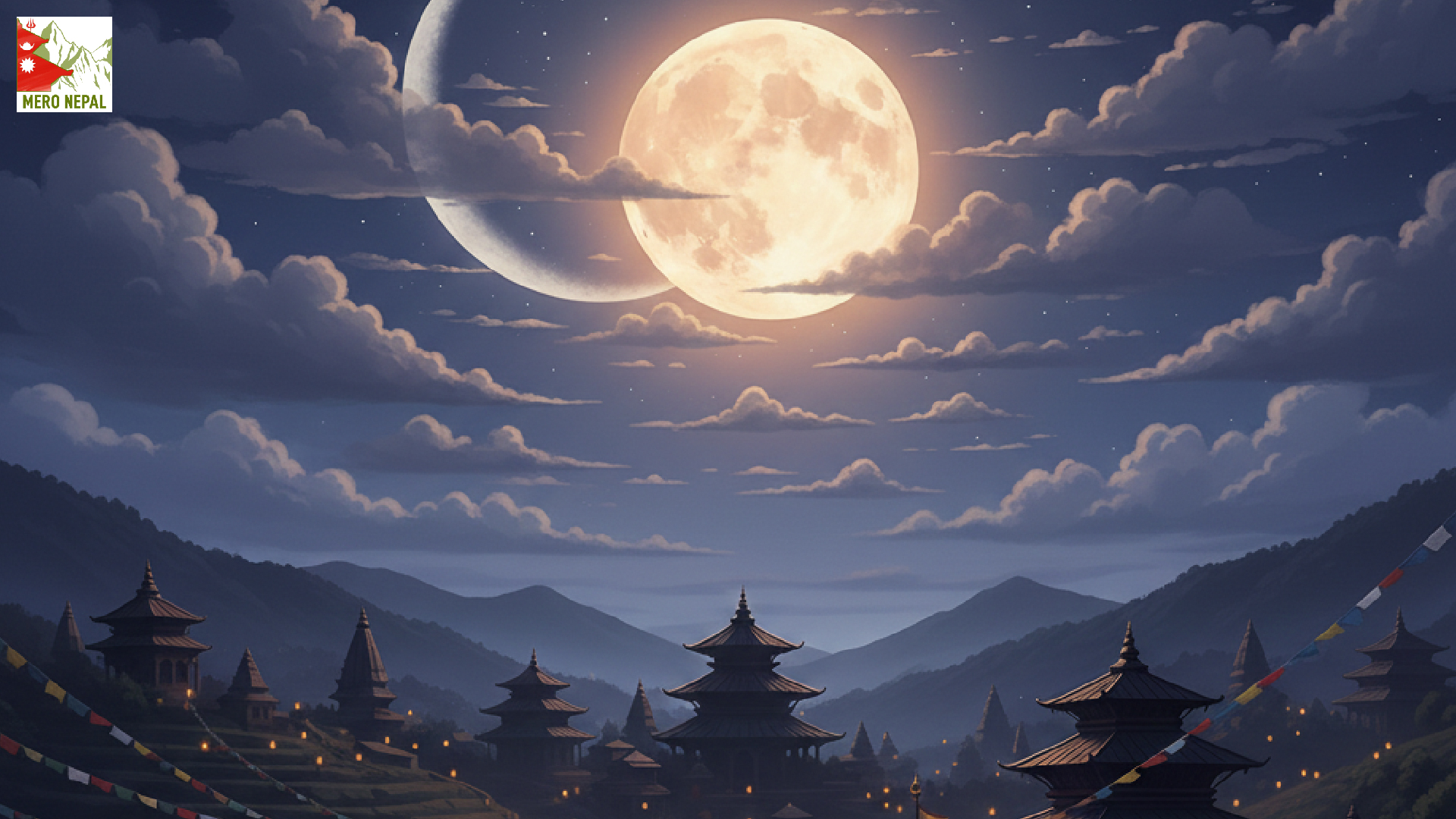
Amavasya and Purnima are two of the most significant lunar phases in Nepali religious and cultural life. They are not merely dates in the lunar calendar but are deeply connected with rituals, fasting, ancestral remembrance, meditation, and collective social practices. In Nepal, both Hindu and Buddhist traditions understand Amavasya and Purnima as special periods for balancing energy, guiding mental states, and supporting spiritual purification.
1. Amavasya: Meaning, Identity, and Religious Significance
Amavasya is the lunar day when the moon is not visible in the sky. This phase represents inward awareness, silence, and self-discipline. In Nepali society, Amavasya is closely associated with honoring ancestors, remembering lineage, and maintaining family balance.
Festivals such as Kushe Aunsi, Matatirtha Aunsi, and Bala Chaturdashi are directly linked to Amavasya. On these days, people visit rivers, springs, or sacred places to bathe and offer water in remembrance of their ancestors. This practice reflects a distinctly Nepali cultural tradition that preserves intergenerational respect and responsibility.
2. Amavasya and the Tradition of Self-Reflection
Amavasya is considered a time for internal discipline rather than outward celebration. Practices such as silence, meditation, chanting, and self-evaluation are common. In many Nepali communities, large celebrations, weddings, or major new beginnings are traditionally avoided on this day.
Rather than being viewed as negative, Amavasya is understood as a period for restoring balance and cultivating awareness. It encourages individuals to reflect on their responsibilities, values, and life direction.
3. Mental and Energetic Influence of Amavasya
From an astrological perspective, lunar energy is believed to be minimal during Amavasya. As a result, the human mind may become more sensitive, calm, or introspective. For this reason, meditation, prayer, and restraint are emphasized.
Many households avoid alcohol, meat, and excessive entertainment on Amavasya, believing that such discipline supports mental clarity and emotional purification.
4. Purnima: Meaning, Identity, and Religious Significance
Purnima is the full moon day, when the moon is completely illuminated. It symbolizes clarity, awareness, and the peak of positive energy. In Nepali tradition, Purnima is regarded as highly auspicious for ritual bathing, charity, worship, fasting, and communal religious activities.
Buddha Jayanti is celebrated on Purnima, making it especially sacred in the Buddhist tradition. Similarly, Janai Purnima, Kojagrat Purnima, and other local observances hold deep significance in Nepali Hindu society.
5. Purnima and Social–Cultural Life in Nepal
The bright moonlit nights of Purnima are traditionally associated with devotional singing, religious storytelling, communal prayers, and cultural gatherings. In the past, villages often organized group prayers and storytelling sessions on Purnima nights, strengthening social unity and cultural continuity.
In Nepal’s agrarian society, Purnima also played an important role in farming activities. Crop inspection, planting decisions, and agricultural rituals were often aligned with the clarity and convenience provided by moonlight.
6. Purnima and Mental State
Purnima is believed to heighten emotional sensitivity and activity. For this reason, calm practices such as meditation, breathing exercises, and mindful conduct are recommended. Since Purnima represents energy expansion, acts of charity, service, and positive intention are believed to have greater impact on this day.
7. Amavasya and Purnima: An Astrological Comparison
Amavasya represents restraint, ancestral respect, and inward focus, while Purnima represents illumination, enthusiasm, and social engagement.
Meditation, purification, and silence are considered suitable during Amavasya, whereas collective worship, charity, and community service are encouraged on Purnima.
According to astrological belief, actions performed on these lunar days influence emotions, mental stability, and behavior differently. This understanding explains why Nepali society assigns distinct purposes to each phase.
8. Nepali Festivals and Lunar Phases
Laxmi Puja during Tihar falls on Amavasya, connecting the day with prosperity, household harmony, and well-being.
Kojagrat Purnima is observed with prayers for abundance and stability.
Janai Purnima symbolizes ritual purity, social unity, and personal discipline.
Mero Nepal App
In today’s digital age, having accurate and timely information about Amavasya, Purnima, lunar dates, and Nepali festivals is increasingly important. Mero Nepal App is designed to meet this need by providing the Nepali calendar, daily tithi updates, exact festival dates, ritual guidelines, and informative articles related to Nepali religion, culture, and astrology—all in one place. For readers who wish to better understand the meaning, practices, and proper observance of Amavasya and Purnima, the app serves as a practical and reliable digital reference.
Download link: https://play.google.com/store/apps/details?id=com.meronepal.app
9. Meaning of Amavasya and Purnima in Modern Life
Even in modern urban lifestyles, Amavasya and Purnima continue to offer opportunities to pause, reflect, and restore balance. In times of constant activity and mental pressure, these lunar phases act as natural reminders for mindfulness, self-review, and emotional stability.
Conclusion
Amavasya and Purnima are foundational pillars of Nepali religious, cultural, and spiritual life. These lunar phases guide practices of introspection, ancestral respect, social harmony, charity, and mental balance. Rooted in the lunar calendar, Amavasya and Purnima continue to shape Nepali traditions and daily life in a distinctly indigenous and meaningful way.