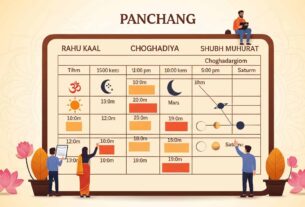
In Vedic tradition, the concept of Shubh Muhurat (auspicious timing) carries deep significance. Time is not just the ticking of a clock—it is the rhythm of the cosmos, influencing every action and outcome. Hindu philosophy views Kaal (time) as an embodiment of Lord Vishnu himself. Thus, any work begun at the right time, in the right direction, and with the right intention is believed to yield successful and lasting results.
In Nepal, it has long been customary to consult auspicious timings before starting any important event—marriage, housewarming, rice-feeding ceremony, initiation, or even the start of a new business. According to Vedic astrology, every planet and star influences the nature of time. When these cosmic forces align harmoniously, that moment becomes a Shubh Muhurat.
Meaning and Vedic Definition of Muhurat
The word Muhurat comes from two Sanskrit roots: Muhu (moment) and Rta (truth or proper order). Therefore, Muhurat means “the right moment” — a period when the universe’s energy aligns positively with human actions.
According to Vedic astrology, there are 30 Muhurats in a day, each lasting 48 minutes. Some are auspicious (Shubh), and some are inauspicious (Ashubh). Determining the right Muhurat involves analyzing five key elements of the Panchang (Hindu calendar):
Tithi – Lunar day or phase of the moon
Vaar – The weekday and its ruling planet
Nakshatra – The constellation active at that time
Yoga – The planetary combination influencing the moment
Karan – Half of a lunar day indicating momentary energy
Astrologers calculate these elements to find the most favorable moment for any undertaking.
Role of Shubh Muhurat in Nepali Culture
In Nepal, auspicious timing shapes both religious and social life.
Marriage Ceremonies: The couple’s horoscopes are matched, and planets are examined to ensure harmony and longevity in marriage.
Housewarming (Griha Pravesh): The timing is chosen based on the Sun’s and Moon’s positions to attract positive energy into the home.
Naming and Rice-feeding Ceremonies: The child’s planetary positions guide the timing to promote health and prosperity.
Starting a Business or New Venture: Days ruled by Mercury, Jupiter, or Venus are chosen for success and wealth.
Rituals and Worship: Religious ceremonies are held during astrologically favorable moments to maximize spiritual benefit.
These practices are not mere superstition—they reflect a lifestyle deeply attuned to natural and cosmic rhythms.
Planetary Energies and Their Influence
Every planet represents a distinct type of energy:
Sun (Surya): Strength, vitality, and leadership
Moon (Chandra): Mind, emotion, and calmness
Mars (Mangal): Courage and physical energy
Mercury (Budh): Intelligence and communication
Jupiter (Guru): Wisdom and prosperity
Venus (Shukra): Love, beauty, and comfort
Saturn (Shani): Discipline and karmic justice
Auspicious timing aligns these energies in a way that supports human intention and effort.
The Scientific Perspective
Even from a scientific point of view, the logic behind Shubh Muhurat can be understood. The positions of the Earth, Moon, and Sun affect gravity, electromagnetic fields, and even human biology.
The Moon, for example, influences psychological states—people tend to feel more emotional during a full moon and more introspective during a new moon.
The Sun affects human circadian rhythms; early morning hours are considered best for meditation and prayer because biological processes are naturally balanced then.
Thus, auspicious timing aligns human actions with natural cycles, promoting focus, confidence, and balance.
Shubh Muhurat in Modern Life
In the digital era, traditional astrology has found new relevance. People now access Panchang calendars, planetary data, and auspicious timings through mobile apps and online platforms.
In Nepal, apps like “Mero Nepal” provide users with personalized horoscopes, planetary insights, and auspicious time predictions. By combining Vedic wisdom with technology, such tools make it easier for modern generations to stay connected with ancient traditions.
The Deeper Philosophy of Shubh Muhurat
At its core, Shubh Muhurat is a philosophy of time management. It reminds us that every action has its perfect moment and that recognizing it brings harmony between human effort and cosmic order.
The Vedas state:
“Kaalanirṇayena siddhyanti karmaani na anyathaa.”
Meaning — “Actions succeed when performed at the right time, not otherwise.”
Understanding Muhurat means understanding life’s rhythm. When one works in alignment with nature and cosmic forces, success follows naturally.
Conclusion
Shubh Muhurat is a living symbol of Vedic wisdom — linking time, energy, and human action. In Nepal, it remains a cornerstone of religious and cultural life, guiding everything from marriages and rituals to business decisions.
Even today, it teaches a timeless lesson: success comes not just from effort, but also from timing.
Mero Nepal App :
Check your personal Muhurat, horoscope, and planetary positions anytime, anywhere.
Download “Mero Nepal App” — where Vedic knowledge meets modern technology.